What Is BlockDAG Mining, and How Does Proof of Work Secure the Chain?
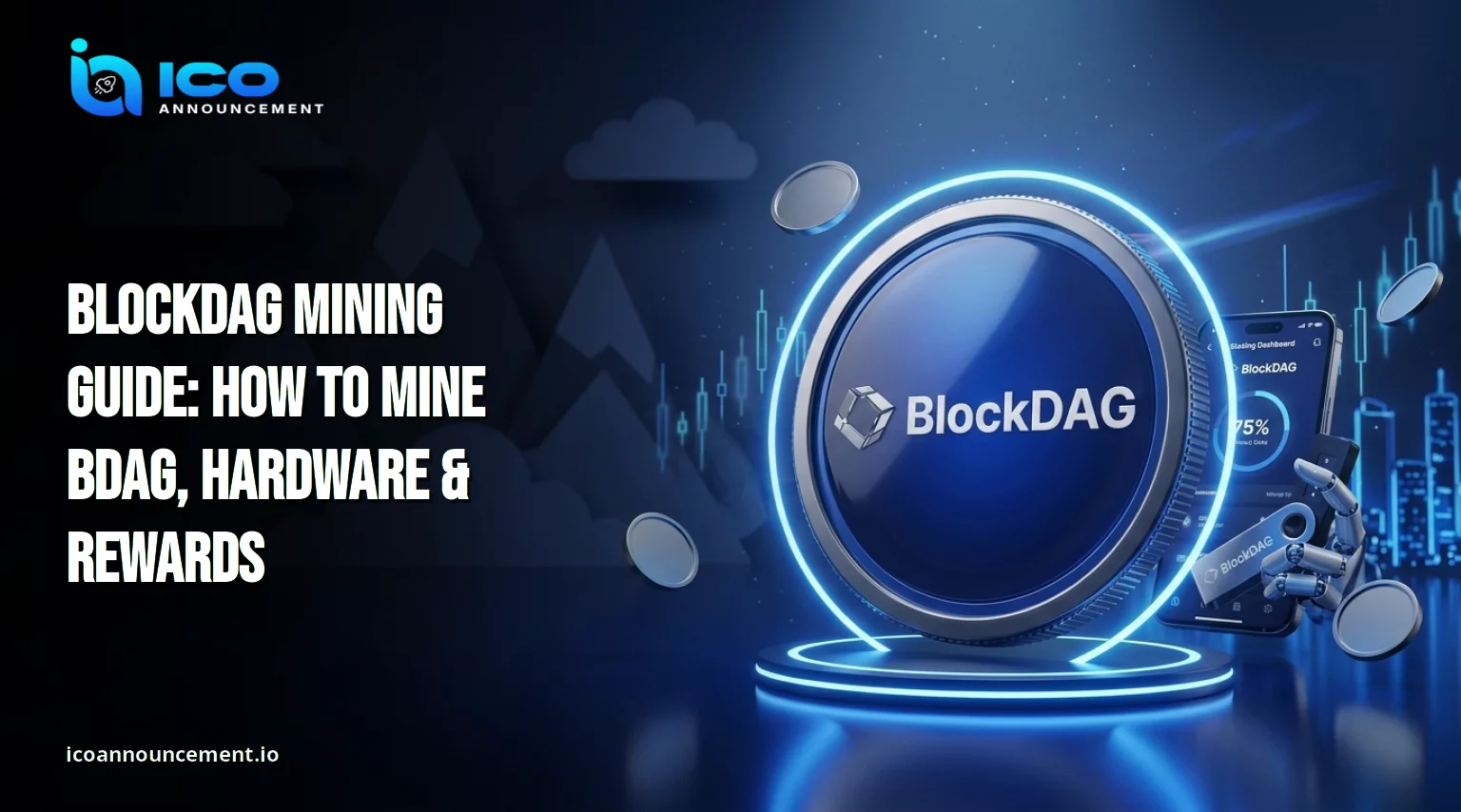
BlockDAG mining is Proof of Work block production for the BDAG chain.
The project’s roadmap lists mainnet block production from February 10, 2026, with ASIC participation live.
Readers asking how to mine BDAG want four answers: which equipment works, how the setup goes, how rewards arrive, and whether the costs make sense.
This guide answers each one from official release notes and flags every figure that comes only from the project’s own marketing.
What Is BlockDAG Mining, and How Does Proof of Work Secure the Chain?
A Proof of Work chain asks computers to solve a puzzle before a block is accepted.
Solving it takes real hash rate and electricity, which makes rewriting history expensive.
The project describes its design as a hybrid of a Directed Acyclic Graph and Proof of Work, so several blocks can be produced in parallel instead of in one line.
Its mining page claims 10 blocks per second, but that figure is the project’s own statement, not an independent measurement.
Miners are the workers who keep the ledger honest, and block rewards are their payment.
To understand how parallel blocks differ from a normal chain, read the BlockDAG Technology Guide.
What Hardware Does BDAG Mining Require? ASIC, Power, and Internet
The official rig page lists a mobile app and three ASIC miner models. The X1 is the app, while the X10, X30, and X100 are physical devices.
The page says each device ships with a power supply and describes the chips as undervolted and built for DAG work.
It does not publish watt draw or noise figures, so confirm those on the product page before paying.
Software and pool support matter as much as the device.
One official note, dated December 29, 2025, reports low hash rate readings on pools running Goldshell units and says engineers were working with that manufacturer on fixes.
It adds that miner-side recommendations would follow once fixes were validated, so look for them before buying a third-party rig. Read the full note in BlockDAG Dev Release 233.
How to Set Up a BlockDAG Miner Step by Step Without Common Errors
BlockDAG’s official setup list for an ASIC rig is short:
Connect the device to a stable power supply.
Use an Ethernet cable, because ASIC units usually lack Wi-Fi.
Find the unit’s IP address in your router and open it in a browser.
Log in with the default credentials from the manual.
Enter the pool protocol, address, and username from your chosen pool.
Check the status page to confirm the device is hashing.
Payouts go to the wallet address you enter, so create and back up that wallet first.
Never share a seed phrase with a pool, a seller, or support staff. For safe storage steps, see the BDAG Wallet Guide.
How Are BDAG Mining Rewards Calculated, and Where Do They Arrive?
The roadmap says on-chain emissions and a halving schedule are enforced at the protocol level, so the chain, not a pool, sets how many new coins exist.
The sources reviewed publish no per-minor payout formula.
In pools, a miner generally earns a share equal to its hash rate divided by the total, minus pool fees. and mining difficulty shifts that share over time.
That is standard proof-of-work logic, not a chain-specific rate.
The rig page also quotes daily figures of 20 BDAG for the X1 app, 200 for the X10, 600 for the X30, and 2,000 for the X100.
Treat these as marketing claims, because real income depends on pool terms, uptime, and difficulty at the time.
Once a payout lands, the BlockDAG Explorer Guide shows how to verify it by address and transaction hash.
Is BlockDAG Mining Profitable? Real Costs Versus Possible Rewards
Profit is gross rewards minus electricity costs, hardware price, pool fees, and the cost of moving coins. A simple formula:
Net daily result = (coins per day × coin price) − (device kW × 24 × power rate)
Here is an illustration with made-up inputs.
A device earns 200 BDAG daily; the price is $0.00002 (the figure listed in Dev Release 256 on August 20, 2026); the unit draws 0.1 kW, and power costs $0.10 per kWh.
Gross revenue is $0.004 per day, while power costs $0.24 per day, a loss of $0.236 before hardware and fees.
The watt figure is invented because no official one was found, and changing any input changes the answer.
Run your own numbers with the project’s calculator. Moving rewards also costs network fees, which the BDAG Gas Fees Guide explains.
BlockDAG Mining vs. BDAG Staking vs. Running a Node: Key Differences
Mining, staking, and running a node are different jobs with different inputs.
Staking needs no rig, which makes it the lower-effort route.
A node supports the chain, and Dev Release 233 says relay fallback is being built into every node.
For the staking route, read the BDAG Staking Guide.
How to Check BlockDAG Mining Updates and Official Network Activity
The development hub says releases are updated every Monday.
Dev Release 256, dated August 20, 2026, covers node, miner, and RPC stability work and reports 17,024,874 total blocks, 4,928,709 transactions, and added server capacity.
Before buying equipment, check the newest notes for miner changes, pool fixes, and difficulty updates.
Check the date on each note, because details from 2024 and 2025 may no longer apply.
Several miner-sales articles found in search are labelled press releases or partner content, so treat the BlockDAG Development Releases page as the primary source.
Final Thoughts: What to Check Before You Buy Any Crypto Rig Safely
BlockDAG mining is documented well enough to follow, yet the reward and profitability figures come mostly from the project itself.
Confirm the current device list, pool support, and power draw on official pages, run your own cost math, and treat any promised income as unverified.
If you cannot show a positive result with your own inputs, wait for newer release notes before spending money.
Disclaimer: This article is for education only and is not financial advice. Hardware purchases involve risk, including costs that may never be recovered. Research independently before buying equipment or tokens.