How BlockDAG Technology Uses Parallel Blocks for Faster Scaling
Picture a highway where every car must wait for the one ahead before moving.
That is how a single-chain ledger handles blocks.
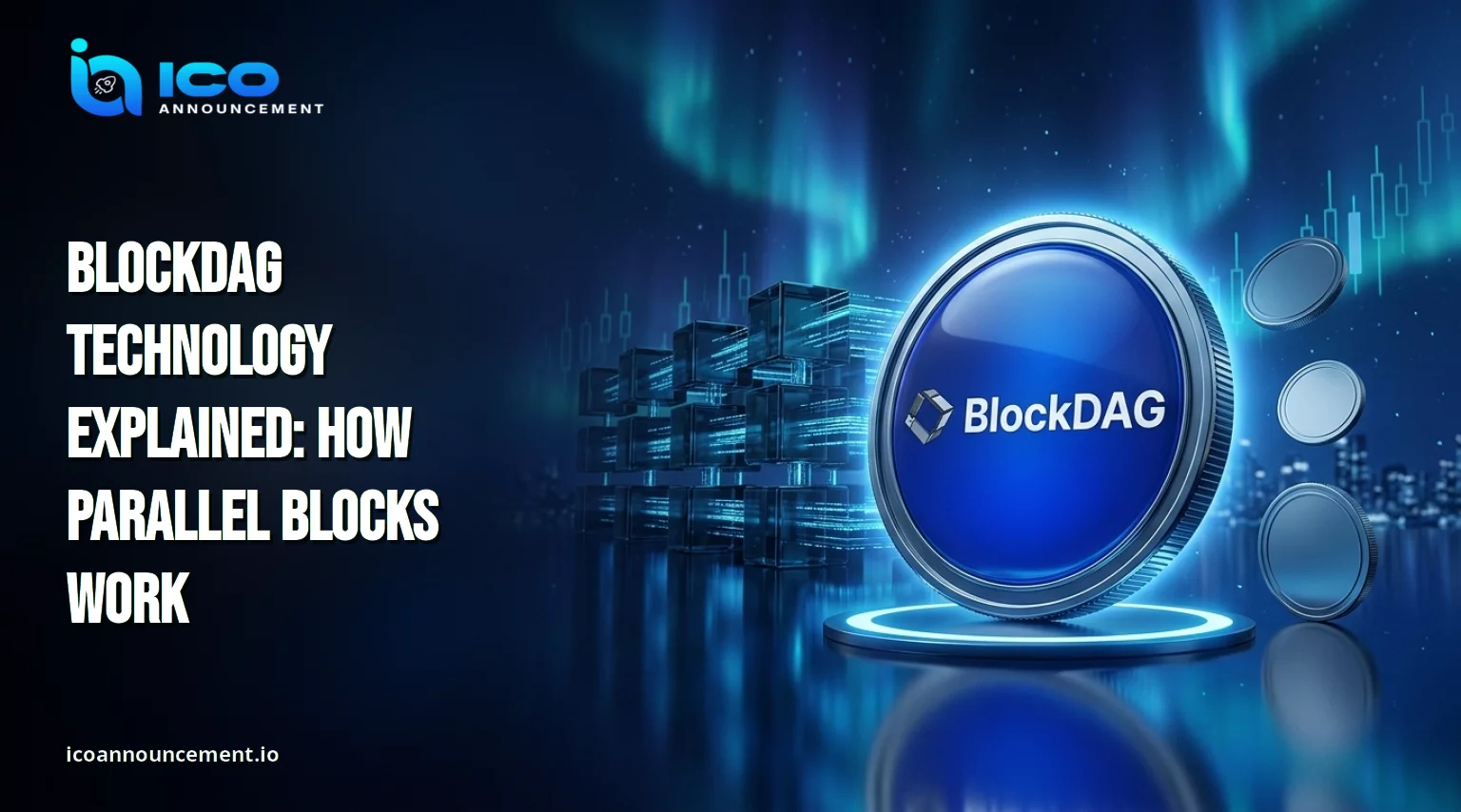
BlockDAG technology takes another route: many blocks form side by side, then merge into one shared history.
This article explains how parallel blocks are ordered, what miners and stakers do, and which claims still need checking.
For the wider product stack around the token, read What Is BlockDAG? A Complete Guide to the BDAG Ecosystem.
Key Takeaways
BlockDAG technology arranges blocks in a directed acyclic graph, so several blocks can exist at the same time.
Mainnet block production started on 10 February 2026, according to the official developer hub.
Security rests on hybrid proof-of-work, with ASIC miners taking part in consensus.
Staking rewards are epoch-based and paid through on-chain contracts.
EVM compatibility lets Solidity developers deploy without a new toolchain.
Throughput numbers are project claims until sustained on-chain usage confirms them.
Why a Single Chain Hits a Ceiling
In a linear blockchain, each block points to one parent.
When two miners find valid blocks at nearly the same moment, the network forks and later discards one of them.
That discarded work is wasted, and the wait for each block caps how many transactions fit into a period.
The root problem is ordering, because one chain forces a strict queue.
A graph structure removes the queue by treating simultaneous blocks as valid contributors instead of rivals.
How BlockDAG Technology Orders Parallel Blocks
A directed acyclic graph lets a block reference several parents, and the graph never loops back on itself.
When two miners produce blocks together, both stay in the structure, and later blocks point to both.
The protocol then applies a deterministic transaction ordering rule, so every node reaches the same sequence.
Conflicting transactions, such as two spends of the same coin, are settled by that ordering, and only the earlier one survives.
The official BlockDAG network site describes its consensus as a hybrid that evolves beyond the DAG protocol used by Kaspa.
The DAG blockchain design gives a practical result: fewer orphaned blocks and more mining work counting toward network security.
Hybrid Proof-of-Work and the Role of Miners
The network keeps proof-of-work as its security base.
The developer hub lists mainnet block production as activated on 10 February 2026, with mining consensus live and ASIC participation.
In DAG designs, a miner whose block arrives slightly late still keeps a place in the structure instead of losing the whole reward to a rival.
The project also offers a mobile mining app and X series hardware, though dedicated rigs carry most of the hash power in any proof-of-work system.
For product details, see the BDAG ecosystem guide.
Staking and Epoch-Based Rewards
Staking runs alongside mining.
The project's development releases report on-chain, epoch-based BDAG rewards active on mainnet as of 2 March 2026, distributed through deterministic smart contracts.
Here is how BDAG staking rewards work: in each epoch, a share of rewards is split among stakers in proportion to their stake.
Returns therefore move with the total amount staked, so a yield quoted today can differ next month.
Stakers should confirm claim windows and cooldowns on the official staking dashboard before locking tokens.
What EVM Compatibility Means for Builders
The BlockDAG mainnet page lists interoperability with the Ethereum ecosystem and low-code developer tools.
EVM compatibility means Solidity contracts, familiar wallets, and standard libraries work without a rewrite.
The development releases show the explorer, IDE, and contracts wizard going live in February 2026, while the roadmap names lending, oracles, and account abstraction as later phases.
Roadmap items are plans, so check current documentation first.
Risks and Checks Before Relying on the Network
Technology claims and market facts are separate questions.
Throughput figures come from the project, and sustained usage is the real test.
Supply figures have also shifted across phases, so verify the current total and maximum supply on CoinMarketCap before quoting them.
That page has also displayed a notice pointing to a DL News investigation into funding discrepancies and contract allegations, which readers should review directly.
Check 24-hour volume and listed exchanges there as well.
Expert Opinion
An editorial review of the project's public releases shows that the case for BlockDAG technology rests on three checkable items: continuous block production since February 2026, on-chain reward contracts, and a working explorer.
Independent verification of throughput and decentralization remains limited in public sources, which keeps the speed story at the claim stage.
Adoption metrics such as active addresses and contract deployments will matter more than roadmap announcements.
BlockDAG technology will be judged by measured usage over several quarters, not by launch-era headlines.
Disclaimer
This article is for informational purposes only and is not financial or investment advice. BDAG is a volatile asset, and technical claims may not translate into market performance. Readers should do their own research and consult a qualified adviser before investing.