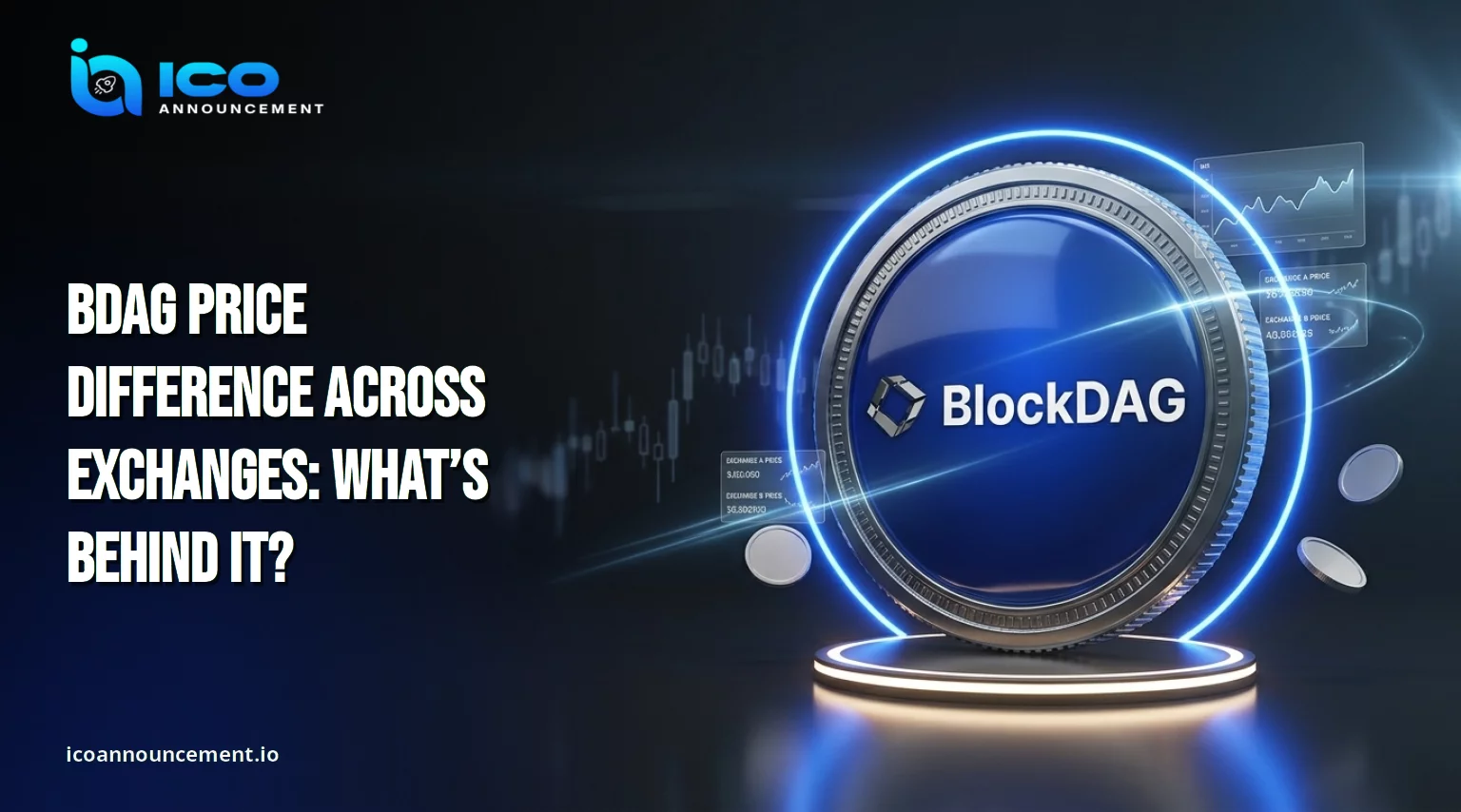
Why Is There a BDAG Price Difference on Every Crypto Exchange?
Why does one token show a different quote on every platform you open? For BlockDAG, the BDAG price difference usually comes from market structure, not from one “true” rate.
Each venue runs its own order book, its own pool of buyers and sellers, and its own deposit and withdrawal rules.
When those pieces do not connect, a cross-exchange price gap can stay open for days. It also shows why a lower quote is not automatically a bargain.
This guide explains what drives the gap, what official sources say, and what holders should verify before they buy, send, or sell.
Why Is There a BDAG Price Difference on Every Crypto Exchange?
A token that trades on several platforms has no single master price, so the BlockDAG price across exchanges rarely matches exactly.
Every venue sets its own rate from the orders sitting on its own book. If one venue has few active traders, a single large order can move the quote far from the rest of the market.
This is exchange fragmentation: the same asset trades in separate pools that do not share depth.
BlockDAG’s own FAQ says some platforms built trading environments without the project’s liquidity or market makers, which leads to thin books and erratic pricing.
Fees, quote currencies, and trading pairs add smaller gaps on top. Read our BDAG trading guide first if you are still comparing venues and pairs.
BlockDAG Liquidity Explained: How Thin Order Books Change BDAG Prices
Liquidity describes how easily you can buy or sell without moving the quote. A deep book has many bids and asks near the current rate, so a large trade barely shifts it.
A thin book has gaps, so the next order fills at a worse level, which traders call price slippage.
The bid-ask spread, the gap between the best buy and best sell offer, widens when few participants post orders.
Market makers narrow it by quoting both sides, and the FAQ lists tighter spreads and deeper books as their purpose.
Also confirm you are reading the right label, because legacy and newer tickers are easy to mix up, as our guide to BDAG ticker differences explains.
Are BDAG Deposits and Withdrawals Open on All Exchanges in 2026?
Transfer access differs by platform, and it feeds straight into pricing.
A Webot help center notice dated July 17, 2026, said block production on the network had been irregular and transactions might stay unconfirmed for extended periods, so the platform suspended deposits and withdrawals while keeping trading open.
Its September 6, 2026 update says there are no further plans to make deposits and withdrawals available, and trading remains available as usual.
You can read the full Webot support announcement on its help center. That is one platform’s decision, not proof that every venue has stopped transfers.
Always read the notice date, because platform notices are updated as network conditions change.
Check each platform’s deposit status and withdrawal status for the specific network before you send anything.
Why Can You Buy BDAG but Cannot Transfer It Between Exchanges?
Buying on a platform only changes a number in that platform’s internal ledger.
Moving the asset elsewhere needs open deposit and withdrawal rails, a supported network, and a confirmed on-chain transaction.
When any of these are closed, holders on one venue cannot send tokens to another, so arbitrage cannot pull the two quotes together.
The FAQ treats full transferability as a condition for price alignment and says gaps should compress once it is enabled.
Verify the BDAG chain first if balances or networks look wrong, because a transfer sent on the wrong network can be delayed or lost.
Match the wallet address and network on both sides before confirming.
Always confirm the withdrawal fee and minimum amount shown on the transfer screen.
BDAG Arbitrage Explained: Can Traders Profit From Exchange Gaps?
Arbitrage means buying where the quote is lower and selling where it is higher. In theory, that pulls prices together.
In practice, it needs open transfers, enough depth on both sides, and low costs.
The BlockDAG official FAQ lists functioning arbitrage flow, balanced books, and enabled deposits and withdrawals as conditions for fair price discovery.
It is the project’s own explanation, and some of its timeline references belong to earlier rollout phases, so it is not a live status page.
A wide BDAG price difference is only an opportunity if the trade can actually be executed.
Many visible arbitrage opportunities disappear once withdrawal fees, network fees, transfer delays, and slippage are counted.
Never treat arbitrage as guaranteed profit.
How to Check BDAG Trading Volume, Liquidity, and Real Market Prices
Start with the same trading pair on each venue, for example, the token against USDT, and compare the trading pair liquidity side by side.
Open the order book and look at depth near the current rate and at the spread.
A tight spread with deep orders is a more reliable quote than a wide one with empty levels. Next, run a trading volume comparison: a venue with tiny volume can print a last price that few people can actually trade at.
Market trackers list several venues in one table, which makes outliers easier to spot. Compare more than two venues where possible, since a single quote can be an outlier.
Finally, use a block explorer to confirm that your own transfer settled on-chain, and learn how to check BDAG transactions step by step.
What Should BDAG Holders Check Before Sending or Selling Their Tokens?
Run through this list before you send or sell:
- Deposit and withdrawal status for the exact network on both platforms
- Matching network, wallet address, and token contract
- Order book depth and spread on the pair you plan to use
- Fees, minimum amounts, and expected confirmation times
- A small test transfer before any large one
If a transfer stalls, read about pending BDAG transactions before you resend, because duplicate sends can compound the problem.
Exchange status can change without notice, so repeat these checks each time rather than relying on an older notice.
Never share a seed phrase or private key with support staff, a website, or a chat message.
Conclusion
The BDAG price difference between platforms reflects thin order books, fragmented liquidity, and uneven deposit and withdrawal access.
Official sources explain the reasoning, and Webot’s notice shows how one platform’s transfer status can differ from another’s. Compare spreads, depth, and volume; confirm transfer availability; and test with a small amount first.
Different quotes across venues are normal in a fragmented market, while rushed or unverified transfers add avoidable risk. Treat any on-screen gap as information, not an automatic opportunity.
Disclaimer: This article is for educational purposes only and is not financial advice. Crypto assets are volatile and carry risk. Verify exchange status and official updates before you buy, sell, or transfer any token.