RollBlock RBLK: Revenue Share and Token Burn Model Explained
A casino token that raised $12.3 million but reportedly sits on a Uniswap pool worth about $32,000 raises an obvious question: where does the value come from? For RollBlock RBLK, the answer is meant to be casino revenue, not hype.
New readers can start with What Is RollBlock? A Guide to the RBLK GambleFi Platform, then return here for the mechanics.
This article follows the money from wager to buyback, burn, and staking reward and checks how much of each step is proven.
Key Takeaways
RollBlock RBLK links token demand to crypto casino and sportsbook revenue on Ethereum.
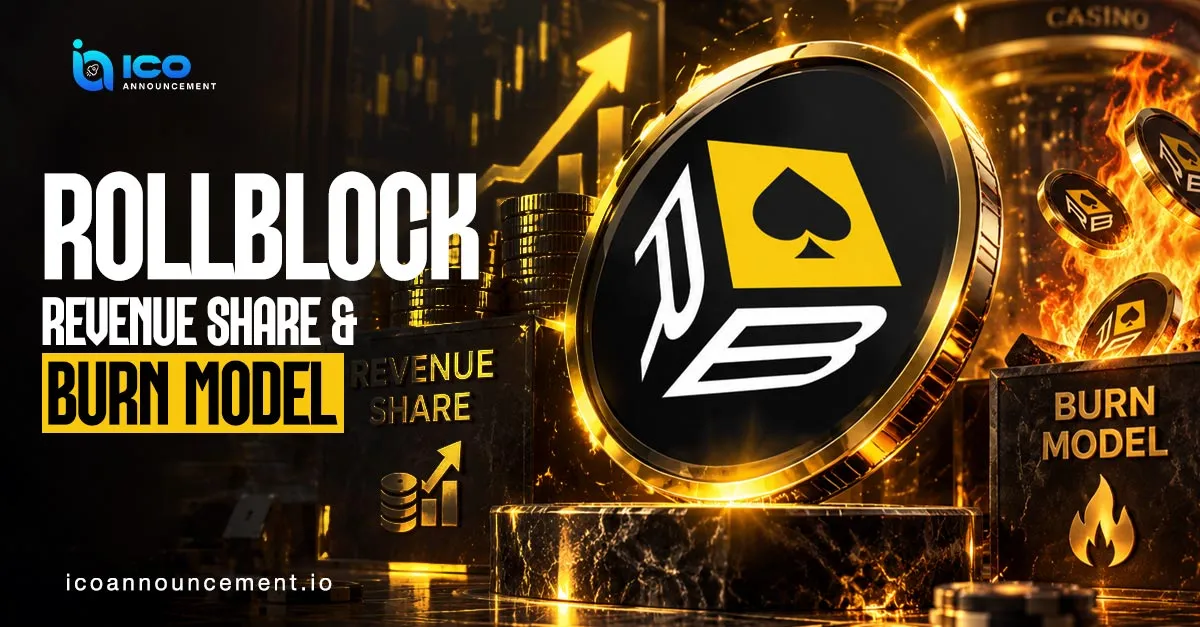
A reported 30% of weekly casino profit funds RBLK buybacks, with 60% burned and 40% paid to stakers.
The presale sold 541,886,528 of 1 billion tokens and raised $12,321,629.
Uniswap trading began on May 18, 2026, after the April 30 target passed.
Reported staking yields near 23% APY can change as more holders lock tokens.
Pool depth and betting volume decide whether the model works.
How RollBlock RBLK Turns Wagers Into Token Demand
RollBlock runs a crypto casino and sportsbook where players deposit crypto, place bets, and earn part of their activity back as rewards.
The house keeps a margin on every game, as any casino does.
The games catalog reportedly spans thousands of titles, including slots, poker, and blackjack, so revenue does not rest on one product. The difference lies in what happens to that margin.
Instead of flowing entirely to a private operator, a set share is routed into open-market purchases of RBLK.
Demand for the token is therefore linked to betting volume rather than a marketing calendar.
A quiet week at the casino means a small buyback.
A busy week means a larger one.
That direct link is the whole investment thesis, and it is also the part that needs verification.
The Buyback and Burn Loop in Numbers
RollBlock's published Native Token tokenomics describe a weekly cycle.
Thirty percent of casino profit buys Native Token on the open market.
Of those tokens, 60% are burned permanently, and 40% go to stakers.
Suppose the casino earns $100,000 in weekly profit.
That would mean $30,000 of buybacks, with $18,000 of tokens burned and $12,000 paid to stakers.
The example is illustrative, not a forecast.
The RollBlock buyback and burn only matter relative to supply, and 541,886,528 presale tokens already entered circulation from a 1 billion total.
Weekly burn size, visible on-chain, is the figure to track, because a token with thin liquidity reacts to even small purchases.
RBLK Staking Rewards and Their Source
RBLK staking rewards come from the stakers' 40% share of repurchased tokens plus platform incentives.
Reported yields have sat near 23% APY, though rates move as more holders lock tokens. A fixed-looking percentage can mislead.
When rewards are paid in a token whose price falls, the dollar return shrinks even if the APY figure holds.
Readers new to the concept can review this beginner guide to crypto staking, then check the live RollBlock staking page for the current rate.
Lock-up terms matter as much as the headline number.
Rewards funded by buybacks also depend on casino profit, so a weak betting month lowers the pool available to stakers.
Presale Numbers Versus Market Depth
Source: RollBlock official channels and the RBLK page on CoinMarketCap. Recheck figures at publish time.
The gap between the RollBlock presale haul and a pool worth a few tens of thousands of dollars is the clearest caution in the story.
The RollBlock Uniswap listing opened quietly, most presale tokens were unlocked, and total value locked stayed small.
A shallow pool moves sharply on modest trades, which cuts both ways for buyers and sellers.
Deeper liquidity would give the buyback and burn cycle more room to matter.
Is RollBlock Safe? Five Checks Before You Buy
GambleFi token risks stack on top of ordinary crypto risk, so a short checklist helps before any purchase.
Run these checks first:
Audit: RollBlock reports a SolidProof audit. Read the report on the auditor's own site.
Contract: Confirm the official RBLK contract on Etherscan, since copycat tokens share the name on other chains.
Liquidity: Check pool depth before sizing any trade.
Regulation: Crypto gambling has no single regulator, so protections differ from licensed casinos.
Volatility: Native Token has traded well below its $0.01 opening price.
None of these checks removes risk.
They only reduce avoidable mistakes.
What to Watch Next
Three milestones decide whether the model is proven.
First, a centralized exchange listing, which the roadmap places in Phase 2.
Second, the mobile apps are also planned for Phase 2.
Third, sustained growth in casino volume, visible through larger weekly burns and deeper pool liquidity.
Earlier target dates, including April 30, passed without a launch, so roadmap dates deserve caution until the event happens.
Holders and prospective buyers of RollBlock RBLK can track each item through official announcements and public on-chain data.
Each milestone is measurable, which is what makes the model testable.
Expert Opinion
The RollBlock RBLK model is coherent on paper.
Revenue-linked buybacks give the token a clearer purpose than most casino coins, and a working games catalog separates the project from whitepaper-only presales.
Evidence for the model at scale remains thin, though.
Shallow pool depth, a quiet launch, and missed earlier deadlines all point to execution risk.
The model earns credit once weekly burns appear on-chain and liquidity deepens without prompting.
Until then, RBLK is best treated as a high-risk speculative asset, not a proven revenue-share instrument.
Disclaimer
This article is for informational purposes only and is not financial, investment, or trading advice. Cryptocurrency assets, including RBLK, are volatile and can lose all value. Verify all details through official project sources and consult a licensed financial advisor before investing.