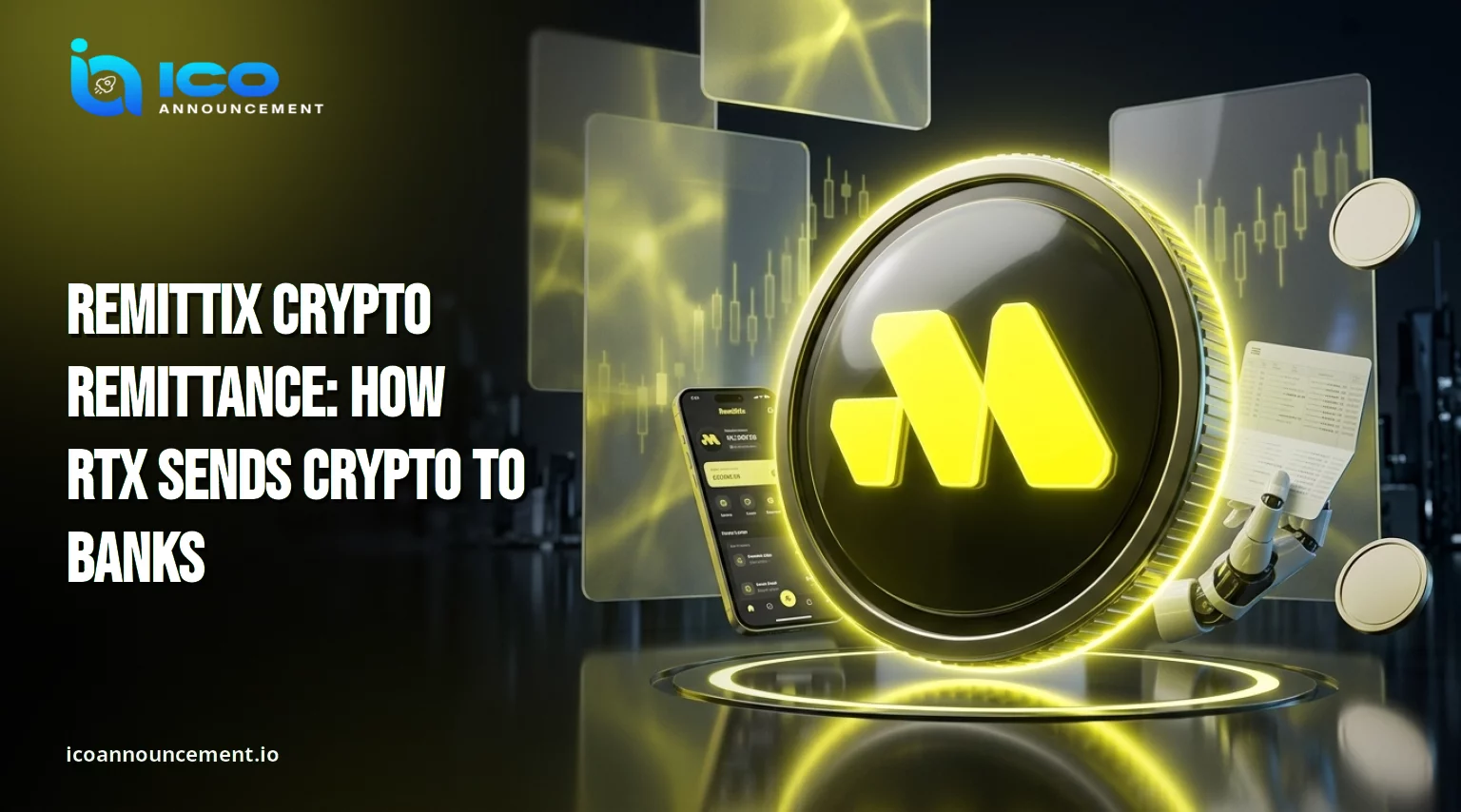
Remittix Crypto Remittance: How RTX Transfers Crypto to Banks
Sending money home still costs too much and takes too long, and the World Bank publishes a public database that tracks those costs corridor by corridor.
Remittix crypto remittance takes a different route.
The sender pays in crypto, and the recipient receives local currency in a bank account.
This guide explains how that model works, where the RTX presale stands on 19 September 2026, and which risks buyers should weigh.
For a wider background, read the complete guide to blockchain transfers first.
Key Takeaways
Remittix is a PayFi project that lets users send crypto while recipients get fiat in a bank account, according to the official Remittix site.
The presale had raised $31.75 million toward a $36 million hard cap by 3 September 2026, per a Remittix press release.
Remittix reported 82.33% of its presale allocation sold on 18 September 2026.
Transfer fees, speed, and country coverage are project claims that vary by corridor and banking partner.
Why Remittix Crypto Remittance Targets the Bank Payout Gap
Most crypto transfers end at a wallet address, which leaves the recipient with a second task: finding an exchange and cashing out.
Remittix aims to remove that step by settling the final leg directly into a bank account.
The project describes itself as a platform that bridges crypto and traditional banking in a compliant way, as stated on its official website.
The idea matters most for families, freelancers, and contractors who are paid in crypto but pay rent in local currency.
A recipient with only a bank account and no wallet can still receive value, which is the core promise of this crypto remittance model.
How a Remittix Transfer Moves From Wallet to Bank
The advertised flow has four stages:
The sender holds crypto in a wallet and chooses an amount and a recipient bank account.
The platform converts the crypto to the payout currency.
Local payment networks carry the funds to the recipient.
The recipient sees fiat in the bank account, often the same day according to the project.
Remittix promotes flat-fee cross-border transfers and same-day processing, but its own materials note that actual availability, timing, and cost vary by country banking partner, and compliance rules, as reported in its 18 September 2026 release.
Identity checks remain part of any regulated payout, in line with the virtual asset standards published by the Financial Action Task Force.
Wallet, Markets, and the RTX Utility Model
Remittix has built more than a payment rail.
The roadmap marks the wallet release and community PayFi testing as complete and lists Remittix Markets as live.
The project says Markets, a perpetual futures platform, has processed more than $50 million in trading volume.
These figures are project-reported and have not been audited by an independent party.
RTX is the token that ties the products together.
A full utility model across PayFi, Markets, and Earn is listed as a coming roadmap step, so buyers cannot yet judge how much demand the token will generate from real payment activity.
Remittix also links to a CertiK assessment of its RTX token contract, which is worth reading directly instead of relying on summaries.
RTX Presale Numbers and the Roadmap Ahead
The presale reached $31.75 million against a $36 million hardcap in early September, and the roadmap ties a $32 million milestone to the reveal of the official launch date.
By 18 September 2026, RTX reported 82.33% of the allocation sold.
The next stages listed on the roadmap include:
Revealing the complete RTX utility model
Upgrading the wallet across all products
Confirming exchange arrangements
Launching RTX on Uniswap with locked initial liquidity
Listing on confirmed centralized exchanges
Each item is a plan, not a delivered result.
Presale completion does not set a future market price, so the roadmap should be tracked against announcements rather than assumed.
Remittix Compared With Standard Crypto Remittance
A standard stablecoin transfer is fast, but it relies on the recipient having a wallet and access to a local exchange.
RTX crypto remittance shifts that burden to the platform, which holds the payout relationship with banks and payment networks.
The trade-off is trust: a wallet-to-wallet transfer settles on a public chain that anyone can verify, while a bank payout depends on the provider and its partners.
For readers new to the category, the Digital Assets remittance explainer on ICO Announcement covers on-ramps, off-ramps, and typical fees.
Comparing that baseline with RTX quotes shows whether the bank payout convenience justifies any extra cost.
Risks to Check Before Using Remittix
Four risks deserve attention.
Regulation differs by country, and a payout corridor can close or slow if a banking partner changes its rules.
Token price can move sharply after listing, as it does for most new assets.
Fees advertised as flat may differ once conversion spreads are included.
Finally, fake support accounts target presale buyers, so only the official channels linked on the project site should be trusted.
A Remittix Digital Assets remittance quote should be tested first, and a sensible check is to compare the quoted cost against the World Bank's Remittance Prices.
Worldwide figures for the same corridor before sending real money.
Start with a small test transfer.
Expert Opinion
The ICO Announcement editorial desk views Remittix Digital Assets remittance as one of the more concrete PayFi concepts in the current presale cycle, because the product targets a measurable pain point and the roadmap lists specific delivery stages.
The desk also notes that the strongest test is still ahead: a public launch with verifiable transaction volume across several payout corridors.
Until independent data confirms fees and speeds, the project claims should be treated as targets.
Readers who want the category basics can revisit the Digital Assets remittance primer linked above.
Disclaimer
This article is for informational purposes only and is not financial, legal, or investment advice. Presale tokens carry a high risk of total loss, and project figures cited here are self-reported. Verify all details on official channels and consult a licensed professional before buying RTX, using Remittix crypto remittance services, or sending money through any digital assets platform.