
Two meme-rooted presale tokens keep showing up on trader watchlists this year, and this Pepeto vs Little Pepe Price Prediction looks at both. Pepeto and Little Pepe both wrap frog branding around staking programs, exchange ambitions, and utility claims. Neither has a mature trading chart yet.
That matters.
Presale pricing isn't market pricing. It moves in fixed stages, not open order books. Comparing PEPETO and LILPEPE means weighing supply, demand, and listing execution together, not a single number on a screen. Both projects sit inside the same crowded, active crypto presale market right now.
The same listing-execution test keeps showing up across broader crypto news coverage, and both PEPETO and LILPEPE will face it too.
This isn't a promise of returns. It's a scenario-based comparison.
That's the honest framing here.
Quick Comparison
Presale prices sit far below any future listing price. That gap is the whole pitch. Market capitalization, not the price tag alone, tells the real story, and that comes next.
Presale-stage tokens span many different crypto categories, and tracking where PEPETO and LILPEPE fit helps traders judge both against the right peer group, not just each other.
Pepeto vs Little Pepe Prices Prediction Compared
Pepeto Presale Price
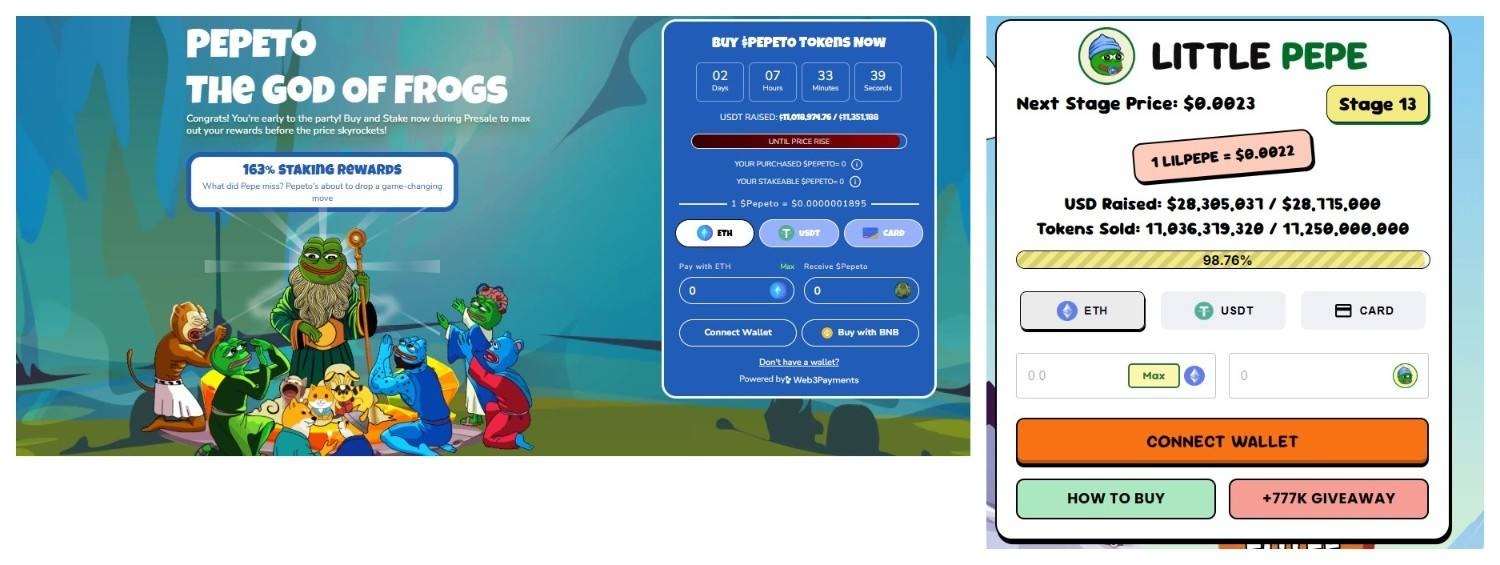
Token trades at $0.0000001895 per token in its current round. The project had raised roughly $11.01 million against an $11.35 million target for this stage, with the dashboard snapshot dated September 16, 2026 . A countdown clock on the same page showed about two days left before the next price step.
Broader market conditions matter too. A related bitcoin whale decision point piece shows similar caution spreading across larger-cap coins right now.
Small numbers. Big implied supply. That combination confuses new buyers more than any chart ever could.
Little Pepe Presale Price
Little Pepe sits in Stage 13, priced at $0.0022, with Stage 14 set at $0.0023. The stage has raised $28,305,031 against a $28,175,000 target, and 98.76% of the stage allocation is already sold, based on the same September 16, 2026 (UTC) snapshot.
Stage 13 is nearly gone. What happens once Stage 14 opens matters more than today's price tag.
Pepeto vs Little Pepe Price Prediction Tokenomics
The token splits its supply across five buckets: 30% presale, 30% staking rewards, 20% marketing, 12.5% liquidity, and 7.5% project development, according to the tokenomics breakdown on Pepeto's site.
LILPEPE divides its 100 billion supply differently: 26.5 billion presale, 13.5 billion staking and rewards, 30 billion chain reserves, and 10 billion each for CEX reserves, liquidity, and marketing.
A lower unit price doesn't mean a cheaper token. Market capitalization equals price multiplied by circulating supply. At current numbers, that's roughly $79.6 million for token and about $220 million for LILPEPE. PEPETO's far larger token count is exactly why its unit price looks tiny next to LILPEPE's.
For a wider view of how these launches typically work, a guide to crypto ICO launches breaks down the stages most new tokens pass through.
Pepeto vs Little Pepe Staking Comparison
The token advertises a 163% annual staking rate, distributing about 32 million PEPETO per Ethereum block over a two-year schedule, claimable once the claim function goes live, per the Pepeto staking dashboard. Over 51.7 trillion tokens are already staked into the pool.
That's a striking headline rate. But headline APY isn't guaranteed yield.
Reward pools that large tend to create selling pressure once claiming opens. Early stakers chasing 163% may end up with a much smaller realized return once emissions dilute the pool.
Little Pepe hasn't published a comparable staking rate at the time of this snapshot. Its 13.5 billion token allocation suggests a program built around listing, not before it.

by team addressed some staking questions directly in a recent posted on X.
Pepeto vs Little Pepe Price prediction Target Math
These are hypothetical, math-based scenarios, not forecasts. Each one assumes listing liquidity holds, demand grows alongside supply, and neither token faces a heavy unlock dump. The LILPEPE bull case also depends on execution timing similar to any crypto IDO holding its schedule without delay.
Would either target actually get hit? Nobody can promise that.
Basically, the math only works if adoption catches up with the supply each project already created.
Pepeto vs Little Pepe Listing Outlook
A presale listing depends on liquidity depth, exchange tier, and timing discipline, not marketing alone. Token presale has already run well past its original schedule, a pattern common across many crypto IEO launches, and shows how a token generation event can slip repeatedly before it ever reaches an order book.
Little Pepe looks closer to a defined exit point, with Stage 13 nearly exhausted and Stage 14 positioned as the final pre-listing phase.
Turns out, the biggest risk at listing isn't the price. It's whether early liquidity can absorb the first wave of selling.
Key Risks
Presale risk sits at the top for both tokens. Funds committed before launch depend entirely on the team finishing what it started.
Liquidity risk follows close behind. Listing with thin liquidity invites sharp swings in both directions.
Supply risk cuts differently for each project. Token staking emissions keep adding new tokens to circulation. LILPEPE's fixed 100 billion cap removes that specific pressure, though its chain reserves and marketing allocations still carry some dilution potential.
Execution risk closes the list. Sentiment can shift fast once a token actually starts trading on any of the major crypto blockchains it eventually lists on.
That's the sober part done.
What Traders Should Watch Next
Presale completion timing matters more than any single price figure right now. So does the official token generation event date for each project.
Watch these markers, roughly in order:
Confirmed TGE date and exchange tier
Opening liquidity depth at listing
Trading volume in the first 24 hours
Token unlock schedule after listing
Staking participation once claims open
Presale-stage tokens rarely follow a straight line to listing, and both PEPETO and LILPEPE still have to clear that final stretch before trading opens.
Not every marker resolves cleanly. Some of it stays fuzzy until listing day itself.
Disclaimer
This article is for informational purposes only and does not constitute financial, investment, or trading advice. Presale tokens carry high risk, including total loss of capital, and price scenarios discussed here are hypothetical illustrations, not predictions or guarantees.