Pepeto Token Claim: When and How to Claim PEPETO Tokens
If you bought PEPETO during the presale, the next question is simple: when do you actually receive your coins, and how do you know the site you use is real? This guide walks through the full token claim process, from the trigger event that opens the window to the wallet setup you need and the scams to watch for before you connect anything.
Key Takeaways
Claiming opens around the token generation event, not the moment the presale sells out
The claim contract has to be activated on-chain before any wallet can release tokens
Always verify the claim page against the project's official channels and its security audit
You need a self-custody wallet, the correct network, and gas tokens on hand
Fake claim pages spike right when a real claim window opens
When Can You Claim Your Pepeto Tokens?
The window does not open the moment the presale sells out.
Most presale projects, Pepeto included, tie token release to a fixed milestone rather than a random date, so buyers who expect an instant payout often wait longer than planned.
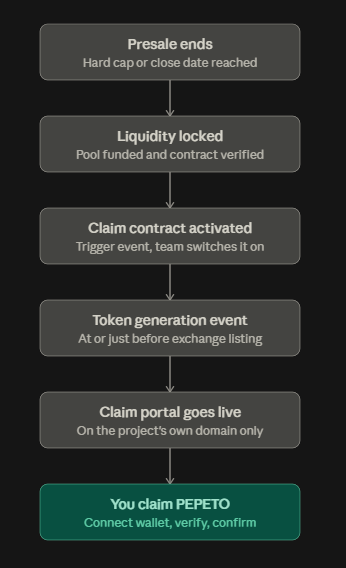
Release typically begins around the token generation event, shortly before or alongside the exchange listing, once liquidity is locked and the contract is verified.
Because presale terms can shift as a launch plan is finalized, check the official listing timeline rather than rely on rumors or countdown pages.
It also helps to confirm whether distribution happens in phases, since some projects release tokens to early backers first, which changes when your specific allocation becomes available.
What Triggers the Pepeto Token Claim?
A presale token does not become available on its own; something has to trigger it.
For Pepeto, that usually means the presale hitting its close date or hard cap, the liquidity pool being funded and locked, and the team activating the release contract on-chain.
Until that contract is switched on, no wallet, official or not, can release tokens early.
This explains why dates sometimes shift by a few days: a delay in funding liquidity or a final audit check pushes activation back.
The clearest way to see how these pieces connect is the project's own roadmap and tokenomics breakdown, which lays out the sequence between presale close, listing, and the Pepeto token claim trigger itself.
How to Claim PEPETO After the Presale Ends
Once the trigger happens, receiving PEPETO follows a fairly standard sequence, but skipping a step is where most mistakes occur.
First, locate the official page through the project's verified website or announcement channel, never a link sent in a direct message.
Second, connect the same wallet address used during the presale purchase, since the contract checks that address against your recorded contribution.
Third, select the correct network before confirming anything, since the wrong chain can fail the transaction.
Fourth, review the details in your wallet before signing, checking the contract address matches the one published by the project.
Finally, confirm and wait for on-chain settlement, then verify the balance actually shows up rather than assuming success.
If you are unsure how your original purchase and wallet were set up, the presale purchase guide covers that side of the process, useful context before you attempt a claim.
Where Will the Official Pepeto Claim Portal Be?
There is no universal portal shared across every presale project, so the official Pepeto-claim page will almost certainly sit on the project's own domain, linked from its verified social accounts rather than a generic aggregator site.
Before the trigger event, bookmark the real homepage now so you are not searching under time pressure later, when copycat sites tend to appear.
A page being live does not automatically mean it is safe; cross-check the contract address shown against the one referenced in the project's independent security audit, since a mismatched address is one of the clearest signs of a spoofed site. Treat any link shared through paid ads or unofficial forwards as unverified until confirmed on the project's own channel.
What Wallet Do You Need to Claim PEPETO?
Receiving PEPETO requires a self-custody wallet capable of interacting with smart contracts, such as MetaMask or a comparable browser or mobile wallet, rather than an exchange account.
Before the window opens, configure the wallet for the correct network, since Pepetos operates across the chains named in its documentation, and using the wrong one simply fails.
A small balance of the native gas token is also needed to cover the transaction fee, which catches out buyers holding only PEPETOs or stablecoins.
Keeping the seed phrase offline and never entering it into a website form matters as much here as during the original purchase.
The wallet setup checklist covers network settings and safety checks in more detail.
How to Check If Your PEPETO Is Ready to Claim
Before assuming something has gone wrong, check whether your allocation is actually marked ready, since not every wallet becomes eligible on the same day if distribution happens in batches.
The project's official tracker, when available, usually shows contribution status against a connected wallet address.
If PEPETOs involves any cross-chain movement between the presale network and its final chain, the cross-chain bridge guide explains how that transfer works and what a pending versus completed transaction looks like.
A transaction pending for an unusually long time is worth checking against the official block explorer rather than resubmitting it, since resubmitting can create a duplicate instead of fixing a delay.
Pepeto Claim Scams: How to Avoid Fake Links
Windows like this are exactly when fake pages spike, because a copycat site can mirror the visual design of a real portal in minutes.
The common pattern is a sponsored search ad or a message in a group chat pointing to a domain that looks almost identical to the official one, sometimes swapping a letter or adding a hyphen.
A legitimate Pepeto token claim page will never ask for your seed phrase or private key, only a wallet connection through a browser extension, so any page requesting those words directly is not official.
Before connecting a wallet, compare the contract address against the one listed in the audit and security report, and confirm the domain matches the link shared on the project's verified account rather than a search result.
What Happens After You Claim PEPETO?
Once PEPETOs lands in your wallet, it behaves like any other ERC-style asset, meaning you can transfer, swap, or hold it depending on your plan.
Some buyers put a portion to work right away, and for that the staking rewards guide walks through how rewards accrue and what lockup terms apply.
Either way, confirm the balance on a block explorer once, just to have an independent record that everything settled correctly.
Conclusion
The Pepeto token claim process comes down to timing, verification, and patience: wait for the trigger event, use only the wallet and network specified, and double-check every link against the project's own channels first.
Buyers who treat the claiming window with the same caution as the original purchase are the least likely to lose funds to a copycat page in the first hours after it opens.
Disclaimer: This article is for informational purposes only and is not financial or investment advice. Presale timelines, claims triggers, and portal details can change without notice; always verify current information through Pepetos official channels before taking action.