
LiquidChain Presale: How Can You Buy and Stake $LIQUID Tokens?
Crypto has a split-screen problem. Bitcoin holds the biggest pile of capital. Ethereum has the deepest DeFi. Solana has the speed. Yet these three barely talk to each other. LiquidChain wants to fix that. It is building a Layer 3 blockchain that ties all three together, and its token sale is now open on the official website. This guide walks through how the LiquidChain presale works, what the technology actually does, and what to check before you spend anything.
Key Takeaways
LiquidChain is a Layer 3 blockchain that joins Bitcoin’s capital, Ethereum’s DeFi depth and Solana’s speed in one execution layer.
The $LIQUID token covers network participation, governance, staking and access to platform features, from a total supply of 11,800,000,100.
CertiK and SpyWolf audits are listed on the official site, but the project is still at presale stage, so risk stays high.
What Is LiquidChain?
LiquidChain is a Layer 3 blockchain built to connect Bitcoin, Ethereum, and Solana. Think of it as a shared layer on top of the big networks, so they act like one market instead of three.
The problem it targets is simple. Most chains run in isolation, so moving assets between them is slow and costly. Bridges and wrapped tokens tried to patch this. The project’s lightpaper says they brought custody risk and slower settlement.
LiquidChain says it works at the coordination level instead of the bridge level. The site boils the promise down to three things: deeper liquidity, faster trading and safer flow. Those three lines sit right under the headline, and everything else in the project backs them up.
There is a builder angle too. Developers of dApps, memecoins, and prediction markets can deploy once and reach users across chains. Project updates go out through the official X account.
What Is $LIQUID Used For?
$LIQUID is the native token of the network. The official website FAQ says it is used for network participation, governance, staking and access to exclusive platform features.
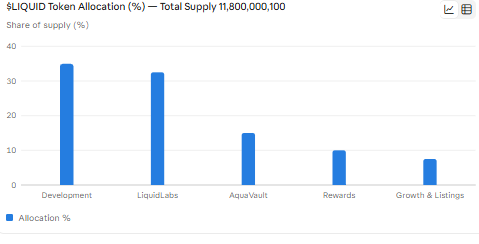
Supply is fixed at 11,800,000,100 tokens. Development gets the biggest share at 35%. LiquidLabs follows with 32.5% for marketing. AquaVault takes 15% for business development and community activities. Rewards get 10% for staking and giveaways, and the last 7.5% goes to growth and exchange listings.
Staking is built into the buying flow. The presale page offers a Buy and Stake option, so you can stake at the time of purchase.
How Does LiquidChain Presale Work? Buying Steps, Wallets, and Payments
The process is short. The page opens with a countdown to the next price rise, a progress bar that tracks funds raised against the stage target, and a Connect Wallet button. Checkout is powered by Web3Payments. Prices step up by stage. The roadmap on the site runs from Stage 1 to Stage 2 and then to exchange listings.
Once the sale ends, tokens are claimed on Ethereum when the claim window opens. The team says timing will come through verified announcements. Fake clones of crypto sites are common. Before you join the LiquidChain presale, make sure you are on liquidchain.com and nowhere else.
How Does Its Layer 3 Blockchain Work?
According to its whitepaper, LiquidChain L3 is not a bridge, a rollup, or a sidechain. It calls itself a settlement layer that pulls outside chain states into one verified structure. Four modules do the job. The execution engine runs on the Solana Virtual Machine. It lets many operations run in parallel while still finishing in a strict order.
The messaging layer carries proofs between chains using LayerZero, Axelar, and Wormhole. The state aggregation module keeps balance and account data from Bitcoin, Ethereum, and Solana in sync through indexers.
Security rests on three ideas. Cross-chain proofs make a transaction complete on every chain or none. A deterministic execution graph removes state races, so there is one order of events. Validators attest to each verified operation, which gives them a stake in the data being honest. The Proof of Execution layer logs every cross-chain operation in a public Proof Registry. It is a record keeper, not a consensus system.
How Does LiquidChain’s Cross-Chain Execution Work?
Every cross-chain action travels as a Proof Packet. Each packet carries a Merkle proof of the source state, execution details such as gas and timestamp, and validator signatures. The network checks Bitcoin UTXOs, Ethereum states, and Solana accounts, then settles the transaction atomically. It either finalizes everywhere or rolls back.
LiquidChain does not hold the liquidity itself. It acts as a non-custodial router. Swaps and transfers run on existing infrastructure, while LiquidChain verifies and indexes them. Users keep self-custody.
On the user side sits the Unified Liquidity Application. It offers portfolio tracking across the three chains, atomic swaps and liquidity routing, plus API access to the Proof Registry.
How Is LiquidChain Different From Traditional Layer 2 Networks?
Traditional Layer 2 blockchain networks mostly scale one base chain, usually Ethereum. LiquidChain sits across three.
These are the project’s own claims. A design on paper is not a live product yet.
Is LiquidChain Worth Watching?
The idea is clear, and the lightpaper is detailed. CertiK and SpyWolf audits are linked on the official site, and you should read the reports yourself. Audits cut risk. They do not remove it.
Before you commit, run a quick check. Open the whitepaper and lightpaper. Read both audit reports. Follow the official X account for updates. Then compare what the team has shipped against what it has promised.
The site also shows listing venues as not yet announced. Live mainnet delivery is the real test. Anyone weighing the LiquidChain presale should only commit money they can afford to lose.
Disclaimer: This article is for information only and is not financial advice. Crypto presales are volatile and can lose all value. Do your own research and speak to a licensed advisor.