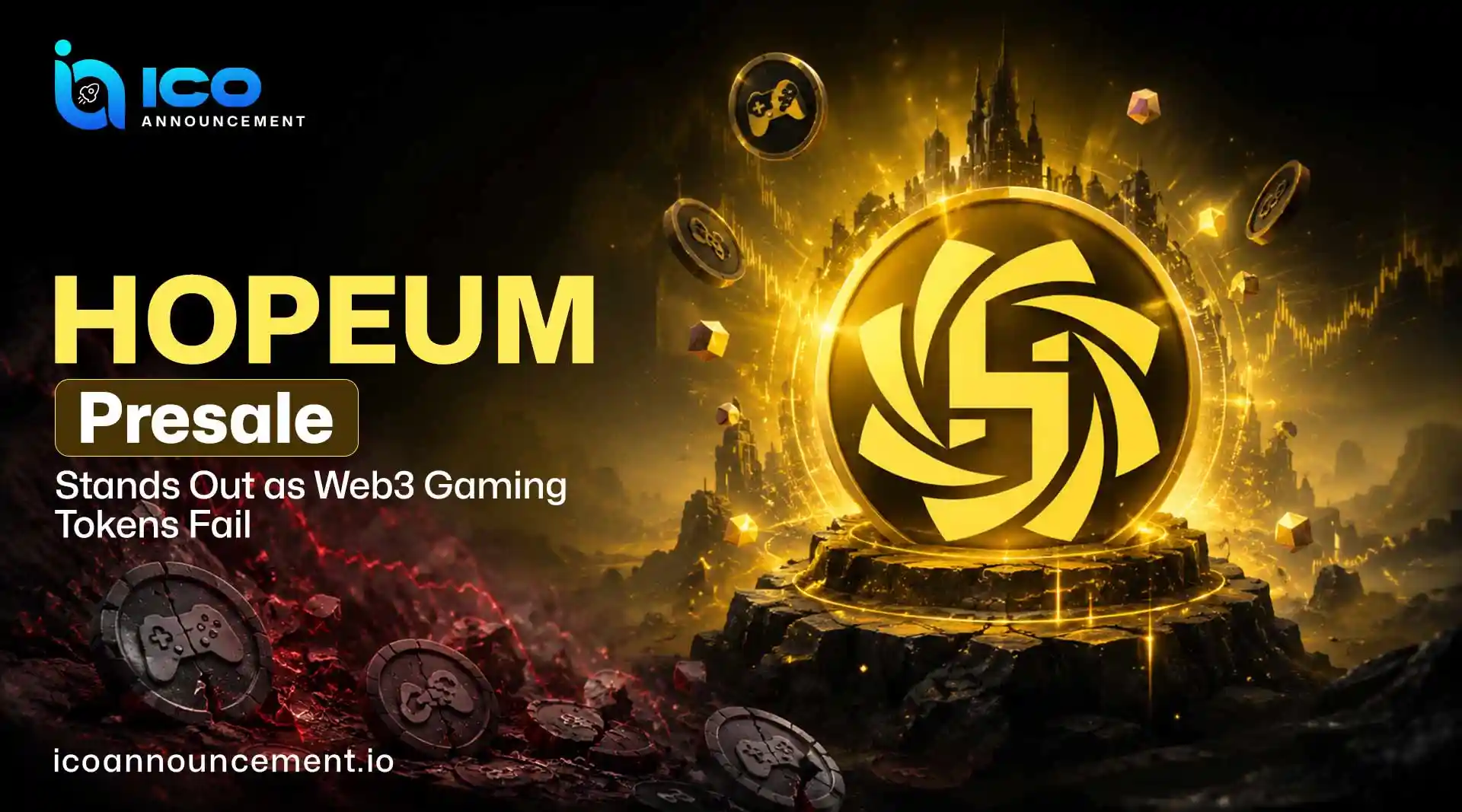
Why HOPEUM Presale Is Different From Failed Gaming Tokens
Web3 gaming was supposed to be the future. Instead, it became a graveyard for investor money.
Over 90% of gaming token launches in 2025 failed to hold their initial value, leaving studios without the revenue they needed to survive. That number is not a prediction anymore. It already happened. And heading into 2026, the same pattern is repeating: new projects, same broken playbook.
So when a new project shows up in your feed, the first question should not be "how much can I make?" It should be "why won't this one fail too?" That is where the HOPEUM presale comes in. And the answer is not hype. It is structured.
What Is HOPEUM Presale?
HOPEUM Presale is the early fundraising phase of the HOPEUM ecosystem, allowing investors to purchase $HOPE tokens before they become available on public exchanges. The project focuses on combining Web3 gaming, blockchain technology, and community-driven growth to create a sustainable digital ecosystem.
During the presale, tokens are typically offered at a lower price than the expected listing price, attracting early supporters who believe in the project's long-term potential. HOPEUM aims to deliver utility within its platform while rewarding active community participation. As with any crypto presale, investors should review the project's roadmap, tokenomics, and risk factors before participating.
Why Most Gaming Tokens Collapse Right After Launch
The failure pattern is almost always the same. A team launches a token tied to a game. Early buyers pump the price. The game has no real users. Token rewards dry up. Holders sell. Price drops. The studio closes.
For many studios, token issuance was the primary financial strategy, and when those tokens failed, there was little fallback revenue. That is the core problem. The token was the business plan. There was nothing underneath it.
Studio shutdowns continued into 2026 as the effects of depleted funding and failed token strategies played out. The market did not forgive anyone for bad design.
When a It has no real demand driver, no spending mechanic, no burn pressure, no income source outside speculation, it only goes one direction after the early hype fades. Down.
Latest Presale Launch
HOPEUM’s latest presale launch is attracting attention as a Web3 gaming-focused project that aims to combine blockchain technology, AI-driven features, and community rewards within a single ecosystem. The presale allows early participants to purchase $HOPE tokens before public exchange listings, with the project highlighting its long-term vision for gaming utility, user engagement, and ecosystem growth. As interest in Web3 gaming projects continues to grow, HOPEUM is positioning itself as a platform focused on real-world utility and sustainable community development.
However, investors should carefully review the project's whitepaper, tokenomics, team background, and security measures before participating in the presale.
Presale details
Start- April 1, 2026
End- June 15, 2026
Total supply- 1,000,000,000
% of supply- 0.30%
Accepted currency- USDT
Price- 0.030
The HOPEUM Presale: A Different Starting Point
HOPEUM is a gaming project built on Ethereum. Its native token is $HPM. The presale opened April 1, 2026, priced at $0.030 USDT per token, with the sale window running through June 15, 2026.
What separates this from the usual gaming token launch is what the HPM actually does inside the system.
HPM is used as in-game currency for titles including Dice, Coinflip, Crash, and Raffle, and is also staked in native and third-party pools to earn yield. Two real use cases. Not just governance, voting rights, and a whitepaper promise.
That matters because constant in-game spending creates consistent buy pressure on the token. Every time a player buys into a game round, HPM gets consumed. That is a demand loop most failed gaming tokens never built.
The RWA Angle That Most Gaming Tokens Skip Entirely
Here is the part that makes the HOPEUM presale structurally different from almost every other gaming launch in 2026.
Hopeum describes itself as one of the first DeFi ecosystems in Africa backed by real economic activity, specifically poultry agribusiness revenue, where 30% of profits are used to buy HPM from the open market and burn it through transparent on-chain transactions.
This is a burn mechanic funded by real-world business income. Not protocol fees. Not a tokenomics schedule written in a whitepaper. Actual revenue from outside the crypto system, flowing back in to reduce HPM supply over time.
Most gaming tokens' burn supply only when transaction volume is high. When trading slows, the burn stops. HOPEUM's burn is tied to agribusiness profits, a separate revenue stream that does not depend on speculation to function. That is the difference between a token that survives a bear cycle and one that does not.
What the 2026 Gaming Token Market Actually Rewards
Games with polished mechanics, clear value propositions, and reliable monetization systems are positioned to outperform those relying solely on incentives. The crypto market in 2026 is not rewarding ambition. It is rewarding infrastructure.
Stable infrastructure for transactions and user onboarding is becoming a baseline requirement rather than a competitive advantage. Projects that skip this die on the launchpad.
HOPEUM's model checks the boxes that survival requires:
In-game utility- HPM gets spent every time a player enters a game. Real consumption, not optional participation.
Staking yield- Shareholders can lock HPM and earn from native and third-party pools. Holding has a reward beyond price speculation.
Deflationary pressure- The RWA-backed buyback and burn reduce the circulating supply consistently over time.
Ethereum base layer- Settlement on Ethereum means liquidity access and ecosystem compatibility that smaller chains cannot match.
None of these are promises. They are design decisions baked into how the token works from day one.
What to Watch After the Presale Closes
The real test for HPM comes after June 15. Watch for the exchange listing announcement, the first on-chain burn transaction from agribusiness revenue, and how staking pool yields hold up in the first 30 days post-launch.
If the RWA burn mechanic executes as described, it will be one of the more unusual and verifiable deflationary events in a gaming token launch this year. If it does not execute, that tells you something equally important.
The 90% failure rate in gaming tokens is not going away. But it is survivable for the projects that actually built something worth surviving.
Disclaimer
This article is for informational purposes only and does not constitute financial or investment advice. Crypto presale investments carry high risk, including total loss of capital. Always conduct independent research and consult a qualified financial advisor before making any investment decision.