Why Dogecoin Trading Volume Is Down 50% and What Traders Watch
Dogecoin trading volume has dropped sharply over the past year.
BSCNews, citing Artemis data, reports that daily DOGE exchange turnover sat between $1 billion and $2 billion in November 2025.
It now reportedly runs between $500 million and $1 billion.
Both ends of that range have been cut in half.
Is that a warning sign? Not necessarily.
A quieter market says something about participation, but it can't tell you where the price goes next.
Here's what the numbers can and can't say.
Key Takeaways
Daily DOGE exchange activity reportedly fell from $1 billion to $2 billion in November 2025 to $500 million to $1 billion now.
The figures come from BSCNews citing Artemis, so treat them as reported data.
Lower turnover doesn't confirm a falling price or lost investor interest.
Read turnover alongside price action, order-book depth, and liquidity across exchanges.
Exchange trades and on-chain transactions measure different things.
Dogecoin Trading Volume Falls From $2 Billion to $1 Billion Daily
According to the BSC News volume report, daily DOGE exchange activity has fallen a lot in 12 months. 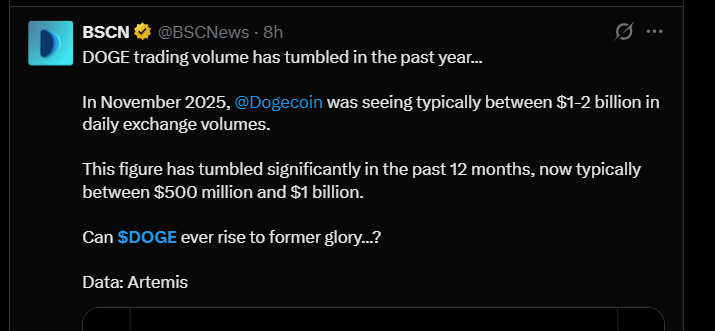
November 2025 brought billion-dollar days. October 2026 shows a lower band. The chart in that post also has sharp spikes followed by quiet sessions.
Volume simply counts how much of an asset changes hands in a set period. A long decline can mean fewer people are trading.
The cause may differ by exchange and by market mood, though. One chart can't settle that question.
What Does Lower DOGE Trading Volume Mean for Traders Right Now?
Thinner activity changes how a market behaves.
When fewer orders hit the book, one large buy or sell can move the price more than it would on a busy day.
That holds in some markets, not all of them.
Turnover works best next to other signals. Price action matters. So do order-book depth and liquidity across venues.
A drop in total turnover doesn't mean every DOGE pair has gone thin. Some pairs may still trade well while others fade.
Exchange Trading Activity vs On-Chain Transactions: Know the Gap
Readers who want the fundamentals can start with these Dogecoin network basics.
One point matters here. Exchange turnover and on-chain transactions are two separate measures.
Exchange figures count trades on platforms. On-chain data counts transfers on the network itself.
A fall in one doesn't automatically mean a fall in the other, so don't swap them when you read a chart.
Is Dogecoin Losing Momentum as Crypto Market Activity Slows?
The decline might reflect changing trader participation, softer sentiment, or less speculation.
The turnover figures alone can't tell us which one it is.
DOGE still moves with the wider crypto market. Social media attention, exchange liquidity, and ecosystem news all feed into it.
The recent DogecoinVM speed upgrade is one example. It introduced a separate payment layer in alpha testing.
Whether it brings steady usage or higher exchange activity is still an open question.
How to Read a DOGE Turnover Chart Without Overreacting to Spikes
One chart invites quick conclusions.
Slow down and check the time frame first.
A 12-month view smooths out short bursts, while a one-week view exaggerates them.
Then look at the spikes.
Sharp jumps followed by calm stretches often appear when news or a price swing pulls traders in for a day or two.
Finally, ask where the data comes from.
The figures cited here come from Artemis, and other trackers may include different venues, so totals can differ.
Can DOGE Trading Volume Recover After the Recent 50% Decline?
It can. Activity tends to rise when participation grows, volatility returns, or fresh news pulls people back. But one spike isn't a recovery.
A better test is persistence.
Does the higher turnover last across several sessions? Does it arrive with a real price move? Compare numbers across multiple exchanges too, and separate spot trades from derivatives.
The Dogecoin price outlook adds market context, though forecasts are never guaranteed.
Disclaimer: This article is for informational purposes only and does not constitute financial advice. Cryptocurrency markets are volatile, and trading volume is only one factor to consider when evaluating market conditions.