What Triggers BlockDAG Staking V2 Activation After the Upgrade?
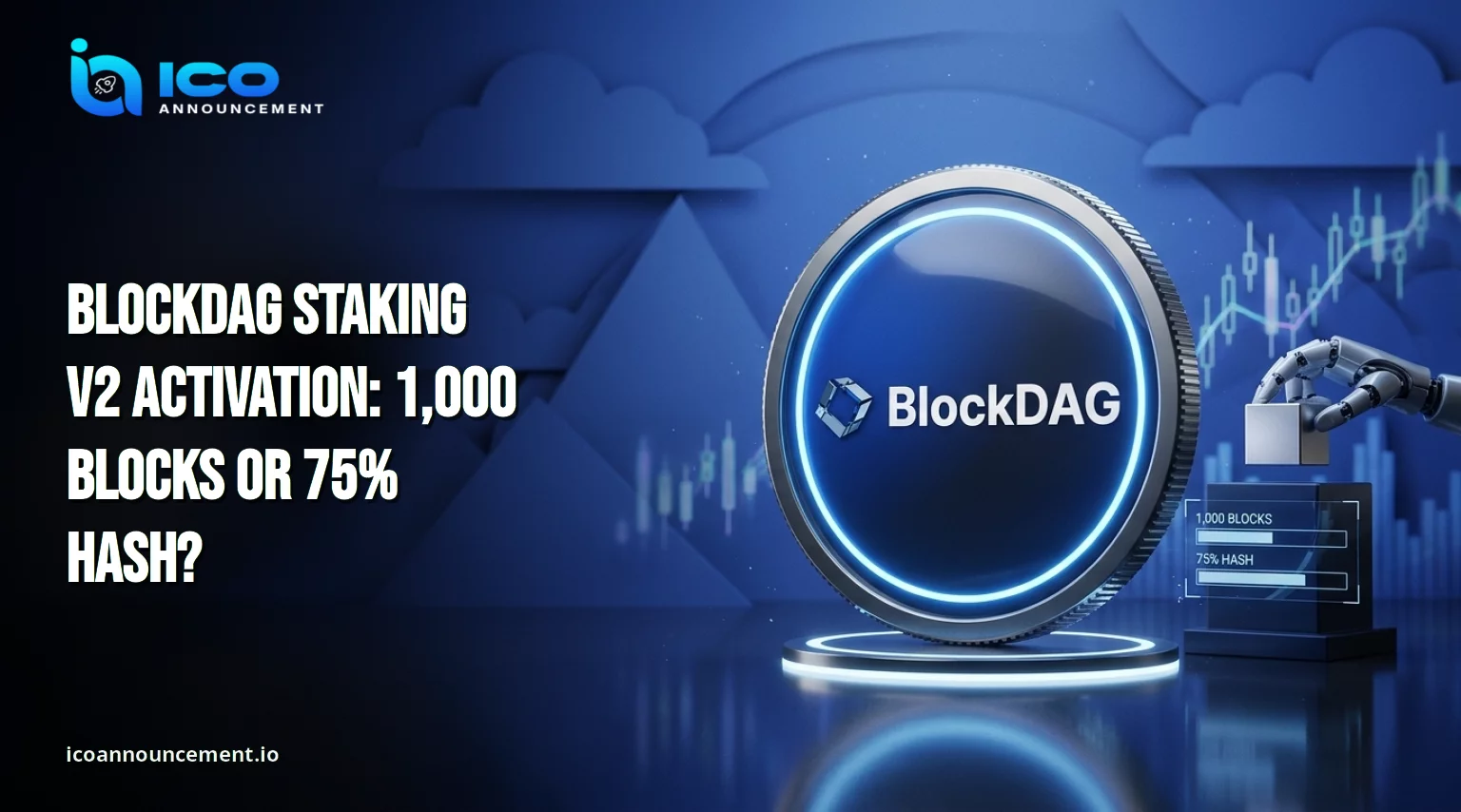
Two community updates published on November 23 describe different triggers for BlockDAG Staking V2 activation. One points to a 1,000-block delay after the upgrade finishes.
The other mentions a 75% hash-power threshold that must hold for 100,000 blocks. Both can be true if they describe different stages of one BlockDAG mainnet upgrade, but neither source proves that yet.
This guide separates the two conditions, explains what each one measures, and lists what holders should verify on-chain before treating it as live.
What Did the November 23 BlockDAG Mainnet Update Actually Confirm?
The first update says the mainnet switchover has started and nodes are migrating to the new release step by step, with no planned downtime. It adds that DAO and Staking V2 are scheduled to activate automatically 1,000 blocks after the upgrade is completed across the network, and that updated contracts will then open to the community. Read the original in the community mainnet upgrade update.
Note the source. The BDAG Community describes itself as independent and says it is not affiliated with the earlier presale, ASIC sales, or fulfillment teams. Treat its posts as community statements, not official company announcements.
Why Does the Second BDAG Update Mention a 75% Hash Power Rule?
The second source is a meeting summary for the week of November 23. It says the new version becomes available once 75% of the hash has been reached, and that this level must then be held for 100,000 blocks for the upgrade to succeed. Only after that are the new system contracts accepted and the frontends launched.
This is a 75% hash power requirement, a hash-power threshold that measures miner adoption rather than the passing of a fixed delay. The summary also says miners and stakers gain DAO voting power. Read it in the BlockDAG protocol meeting summary.
Does the 100,000-Block Requirement Belong to a Separate Stage?
Possibly, because the two statements measure different things. A hash-power threshold shows how much mining power runs the new release.
A block count measures chain progress once a condition is met. Nodes must adopt the new software first, which is why the open-source BlockDAG node release matters: miners cannot signal for an upgrade they have not installed.
As that guide explains, the community's v0.1.2 notes describe lock-in as at least 75,000 signalling layers inside a completed 100,000-layer window, a 75% level.
Native activation then follows a separate delay. On that reading, the 100,000-block hold is a lock-in stage that comes before the final delay.
What Triggers BlockDAG Staking V2 Activation After the Upgrade?
For BlockDAG Staking V2 activation, the 1,000-block statement reads as a final delay applied after the network has finished upgrading. If nodes are only partly migrated, the count has not begun.
This 1,000 block activation is the Staking V2 activation trigger named in the update, but the post does not say which block height starts the count.
A 1,000-block delay is short next to a 100,000-block hold. How long either takes depends on real block production, which you can watch through BlockDAG network TPS activity data. Avoid turning block counts into dates without it.
How Can Holders Verify Staking V2 Activation on Mainnet Safely?
Start with the chain itself. A chain ID alone does not prove you are reading the canonical network, because a public endpoint can report the same ID while serving different block hashes. Use the guide on how to verify the real BDAG chain before trusting any balance or contract reading.
Then use on-chain verification. Confirm the new contract address from a source you trust, check that it shows recent transactions, and compare block heights across two independent endpoints.
A banner or social post is not block-height confirmation. Only on-chain evidence shows that activation has happened.
What Should Existing Stakers Check Before Moving From V1 to V2?
Do not move funds because a post says the new version is coming. Review the existing staking lock conditions first, including the lock period, any unbonding period, and how staking rewards are handled.
Confirm whether legacy staking V1 positions migrate automatically or need a manual staking contract migration. The sources reviewed do not say.
Know how withdrawal works before locking anything new, and never share a seed phrase or private key with anyone offering migration help.
What Is Still Unconfirmed About the BlockDAG V2 Rollout Today?
Several points remain open in the sources reviewed. The posts do not name the block height where counting starts and show no on-chain proof that either threshold was met.
The v0.1.2 notes give a 2,000-layer delay after lock-in, which differs from the 1,000-block figure in the November 23 update, and the sources do not explain why. The project's own development log also showed no matching entry at last check, with Release 257 from November 7 as its newest.
Holders who want to see how DAO activation and community governance screens behave can try the BDAG testnet staking and DAO walkthrough, but a testnet result says nothing about mainnet status.
BlockDAG V2 Upgrade Status: What Holders Can Say With Confidence
The sources confirm that the rollout began, that nodes are migrating, and that two separate conditions were published.
They do not confirm that those conditions describe the same step or that BlockDAG Staking activation has occurred. Until on-chain evidence appears, treat the upgrade as announced, not live.
Disclaimer: This article is for informational purposes only and is not financial or investment advice. Crypto assets carry risk, including loss of funds. The sources cited are community-run, not official company statements. Verify every detail independently before acting.