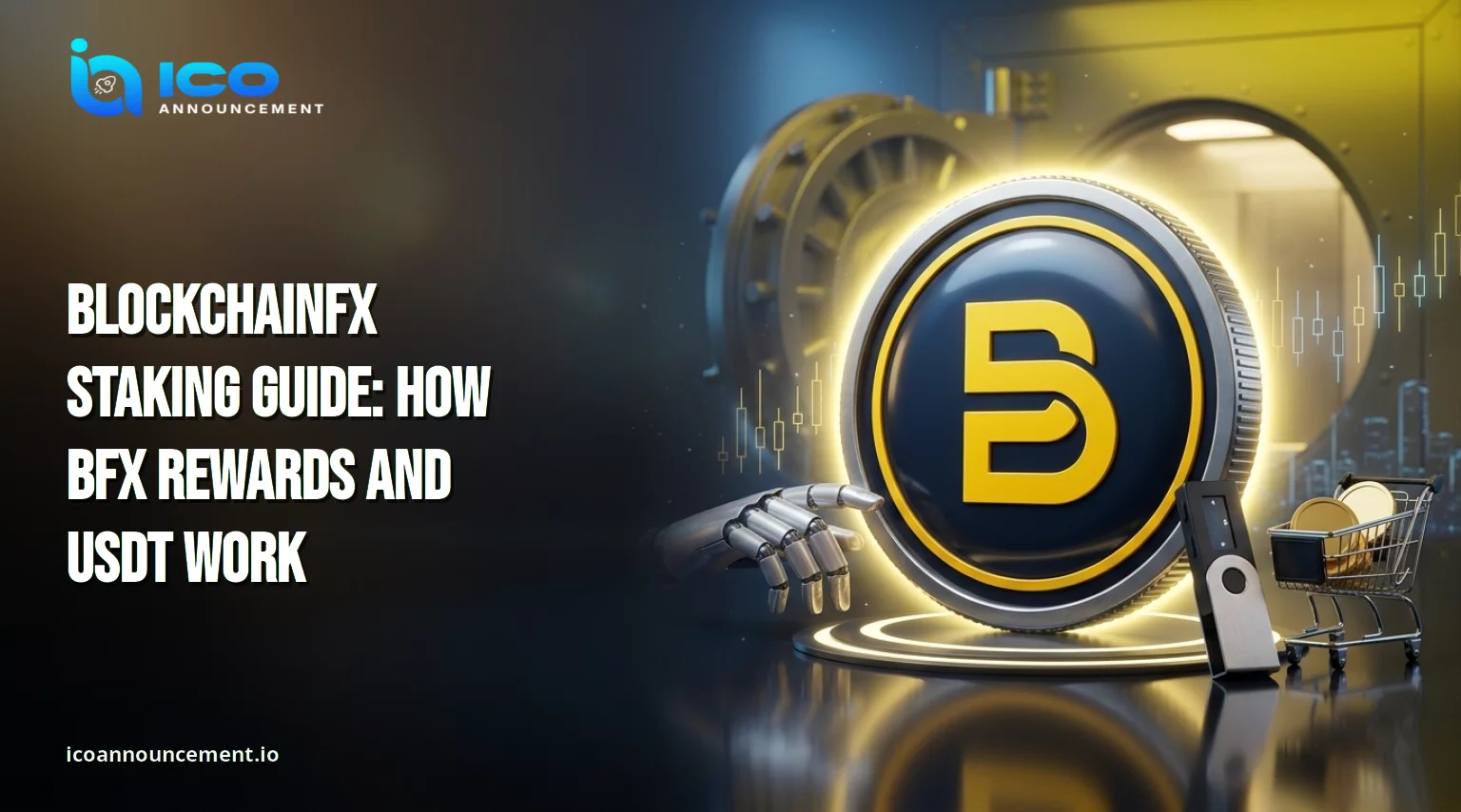
BlockchainFX Staking Guide: How BFX Rewards and USDT Work
Anyone holding BFX during or after the presale eventually asks the same question: how does staking actually pay out? This BlockchainFX staking guide breaks down where the rewards come from, how BFX and USDT payouts are calculated, and what stakers should check before locking in tokens.
It also connects the pieces covered in our BFX super app guide and the buying BFX on Uniswap walkthrough, so new holders can see the full picture in one place.
Staking on BlockchainFX is not a fixed-yield savings product.
It is a fee-sharing system tied to how much trading volume moves through the platform.
That distinction matters because it changes how a holder should think about returns, timing, and risk.
The presale itself has already drawn thousands of participants using ETH, USDT, BTC, and several other assets as funding options, alongside card payments.
Understanding how yield-earning rewards flow once tokens are held is a natural next step after buying, and it is the focus of the rest of this guide.
Key Takeaways
Staking rewards on BlockchainFX come from platform trading fees, not token inflation.
Fifty percent of collected fees fund the staking pool, paid out in BFX and USDT.
USDT rewards are capped at 25,000 dollars per day and distributed weekly.
Twenty percent of fees go to buybacks, with half of repurchased tokens burned.
Reward size scales with contribution tier and platform trading activity, not a fixed rate.
What Is BlockchainFX Staking?
BlockchainFX positions itself as a multi-asset trading super app, covering crypto, stocks, forex, and commodities in one dashboard, a structure explained in more depth in our BFX super app guide.
Staking sits on top of that trading activity rather than existing as a separate product.
When a user stakes BFX, they are not locking tokens into a smart contract that mints new supply.
Instead, staked BFX qualifies the holder for a share of the fees the platform collects from its 500-plus tradable assets.
The more the platform trades, the larger the pool available to stakers.
This BlockchainFX staking guide treats that fee-sharing model as the starting point for everything else, including how USDT rewards are calculated and how often payouts land in a wallet.
How BFX Staking Rewards Work
Half of all trading fees collected across the platform are routed directly into the staking pool.
That pool is split between BFX and USDT, so stakers receive a mix of the native token and a stable asset rather than one or the other.
Rewards accrue daily based on trading volume, which means payout size is not fixed week to week.
A high-volume trading period on the platform can push staking rewards higher, while a quiet period does the opposite.
This is closer to a revenue-share model than a traditional annual percentage yield, and it is the main thing this BlockchainFX staking guide wants new stakers to understand before comparing BFX to fixed-rate staking products elsewhere.
How USDT Rewards Are Distributed
USDT rewards are the part of the system most new holders focus on first, since they represent a stable payout rather than a token subject to price swings.
BlockchainFX caps daily USDT rewards at 25,000 dollars across the platform, and distribution runs on a weekly schedule, paid out every Monday.
Because the cap applies at the platform level rather than per wallet, an individual staker's share depends on their proportion of total staked BFX at any given time.
Larger or longer-held positions generally see a steadier share of the weekly payout.
Anyone evaluating whether the reward structure is credible should also look at how the platform's security posture has been reviewed, which is covered in the CertiK audit dashboard report.
Staking Tiers and Bonus Structure
BlockchainFX uses contribution tiers rather than a single flat asset locking rate.
Entry-level participation starts at a lower contribution threshold, while higher tiers unlock added perks such as bonus token allocations and platform trading credits.
Twenty percent of platform fees are also directed toward buybacks, with half of the repurchased BFX permanently burned.
That burn mechanism is separate from Asset Locking rewards but affects long-term token supply, which indirectly matters to anyone weighing whether to stake short-term or hold through multiple reward cycles.
How to Start Staking BFX
Asset Locking Native Token starts with acquiring tokens through the official BlockchainFX platform or a supported decentralized exchange.
Holders who purchased through Uniswap can follow the process outlined in our guide to buying BFX on Uniswap, which walks through wallet connection and swap steps in detail.
Once Native Token is in a connected wallet, asset locking is managed from the platform dashboard rather than a separate contract interface.
Rewards begin accruing once tokens are staked, and both Native Token and USDT payouts appear in the dashboard on their respective schedules.
Risks and Considerations
Because rewards are tied to trading volume rather than a fixed rate, payouts can vary meaningfully between weeks.
This BlockchainFX Asset Locking guide treats that variability as the main risk to plan around, rather than a smart contract exploit or custody issue on its own.
Presale-stage tokens also carry the usual risks of any early-stage project, including limited trading history and price volatility once tokens list on exchanges.
Reviewing independent security coverage, including the BlockchainFX security audit details published separately, is a reasonable step before committing a large position.
Reward math can also shift if the platform changes its fee split or cap structure over time, so it is worth checking the dashboard's current terms rather than relying on figures from an earlier presale phase.
Expert Opinion
Analysts who track presale reward structures generally note that fee-sharing models like BlockchainFX's tend to reward platforms with genuine trading volume rather than token emissions alone.
That said, the same analysts caution that variable payouts make Native Token Asset Locking harder to forecast than fixed-yield alternatives and recommend treating early reward figures as indicative rather than guaranteed.
Disclaimer
This article is for informational purposes only and does not constitute financial advice. Cryptocurrency Asset Locking and presale participation carry risk, including loss of principal. Readers should conduct independent research before making any investment decision.