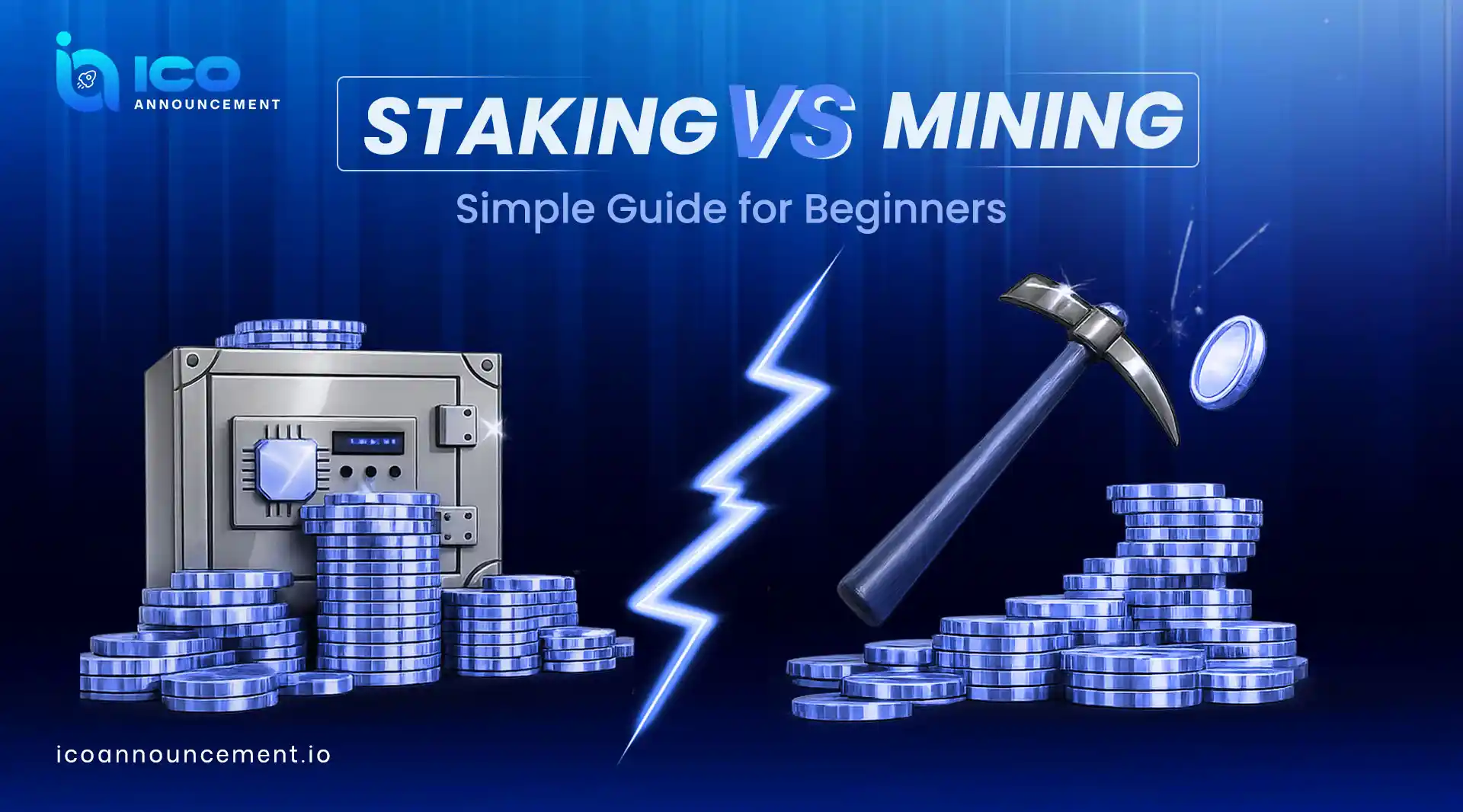
Staking vs Mining: Which Crypto Earning Method Is Right for You?
Crypto is gaining ground, and countless people are seeking the easiest ways to profit from it. Two popular ways of doing this are Staking vs mining. Both keep blockchain networks functioning, but they have very different ways of operating. Nothing to stake on the platform that holds your coins locked up within a network, earning interest as time goes on. It refers to solving problems and adding blocks with powerful computers. As a result, there is a lot of confusion among beginners regarding which one to choose.
I will try to explain both in simple terms for a beginner. Staking vs mining typically needs less money and less power, so it seems easier to begin. It can also reward you, but requires machines, time, and more upfront investment. If you want to learn how mining works from scratch, this guide is helpful. In this article, learn how crypto works, its key differences, and which option might be better for your needs. You can also learn how to earn rewards through crypto Staking vs mining for more details
What Is Staking?
Staking is a way people use their cryptocurrency to earn rewards. It’s not like keeping money in a bank, though it sounds a bit similar. Basically, when you stake, you lock up some of your crypto in a network. The network uses it to help run itself. You can think of it as giving your coins to help the system stay secure. In return, you sometimes earn more coins. If you want a step-by-step guide to earn money with staking, check out this detailed article.
Not every coin allows staking. Popular ones that do include Ethereum, Solana, and Cardano. Ethereum moved to staking after switching to proof-of-stake from proof-of-work. This means it no longer relies on mining with computers, but on people holding and staking their ETH to secure the network.
When you stake, you are technically participating in the blockchain’s consensus mechanism. The network “trusts” that you will act honestly. If you don’t, sometimes you can lose part of your staked coins. This is called “slashing.” It has a risk side too, even though it can earn passive rewards.
How Staking Works
You purchase a staking-enabled token in the first place.
You secure that token in a wallet
Your coins get used by the network to verify transactions
You get rewards over time
Crypto earns rewards based on the amount you stake, so the more you stake, the more opportunities you will have. But rewards are not fixed.
What Is Mining?
Meaning is what grounds something in sense or worth. It can pertain to words, actions, objects, or life itself. For instance, a word means something because everyone agrees on what it means. A gesture such as a smile has meaning because it expresses happiness, friendliness, or comfort. Meaning can even belong to objects, such as an item of family jewelry, which often holds memories or emotions.
In our lives, meaning is often the reason why we do things; what is important to us or what we care about. It could be different according to culture, belief, or personal experience. Others find meaning through relationships, work, or art, and helping others. Others seek it through learning, spirituality, or deep thought.
Meaning isn’t always obvious or fixed. It’s something we create, notice, and interpret, giving our experiences depth and significance beyond just the surface.
How Mining Works
A computer tries to solve a math problem
Many computers compete at the same time
The fastest one wins
A new block is added
The miner gets a reward
This process uses a lot of electricity. It also needs special hardware.
Key Difference Between Staking and Mining
Benefits of Staking
Low Cost Start- You can begin with little money. No need for expensive tools.
Less Energy Use- It does not use heavy power like crypto mining.
Simple Setup- Many apps and wallets make it easy.
Passive Income Feel- You earn rewards while holding coins.
Less Noise and Heat- No machines running all day.
Benefits of Mining
Strong Network Security- Crypto helps keep networks very secure.
High Reward Chance- If done right, rewards can be good.
No Need to Hold Coins First- You earn coins by them.
Control Over Process- You run your own system.
Trusted Model- It has been used for many years.
Which One Is Better?
There is no single answer. If you want something simple, it feels easier. If you like technical setup and have a budget, mining may suit you.
It depends on:
Your budget
Your time
Your risk level
Your knowledge
Real-World View
Many newer blockchains rely on Staking vs mining instead of mining. It’s easier for people to join, and it uses much less energy. You can explore new blockchain projects to see how they are innovating. It is still around, mostly in some of the older, bigger networks, but it consumes a lot of electricity.
It has become more popular over the past few years. As the costs decrease and become more energy-efficient, people would rather that be how they support blockchain networks. As networks increasingly seek sustainable and accessible options, It is growing in popularity.
Final thoughts
Both staking and mining support crypto networks, but they will suit different types of people. It is low-cost, easy to begin with, and simple. More money, more time, and heavy machinery are needed to mine. All methods have their own risks and rewards, so choose wisely. Before you get started, think about your budget, talents, and goals. Both options can allow you to earn, if you understand how they work and manage risk carefully.