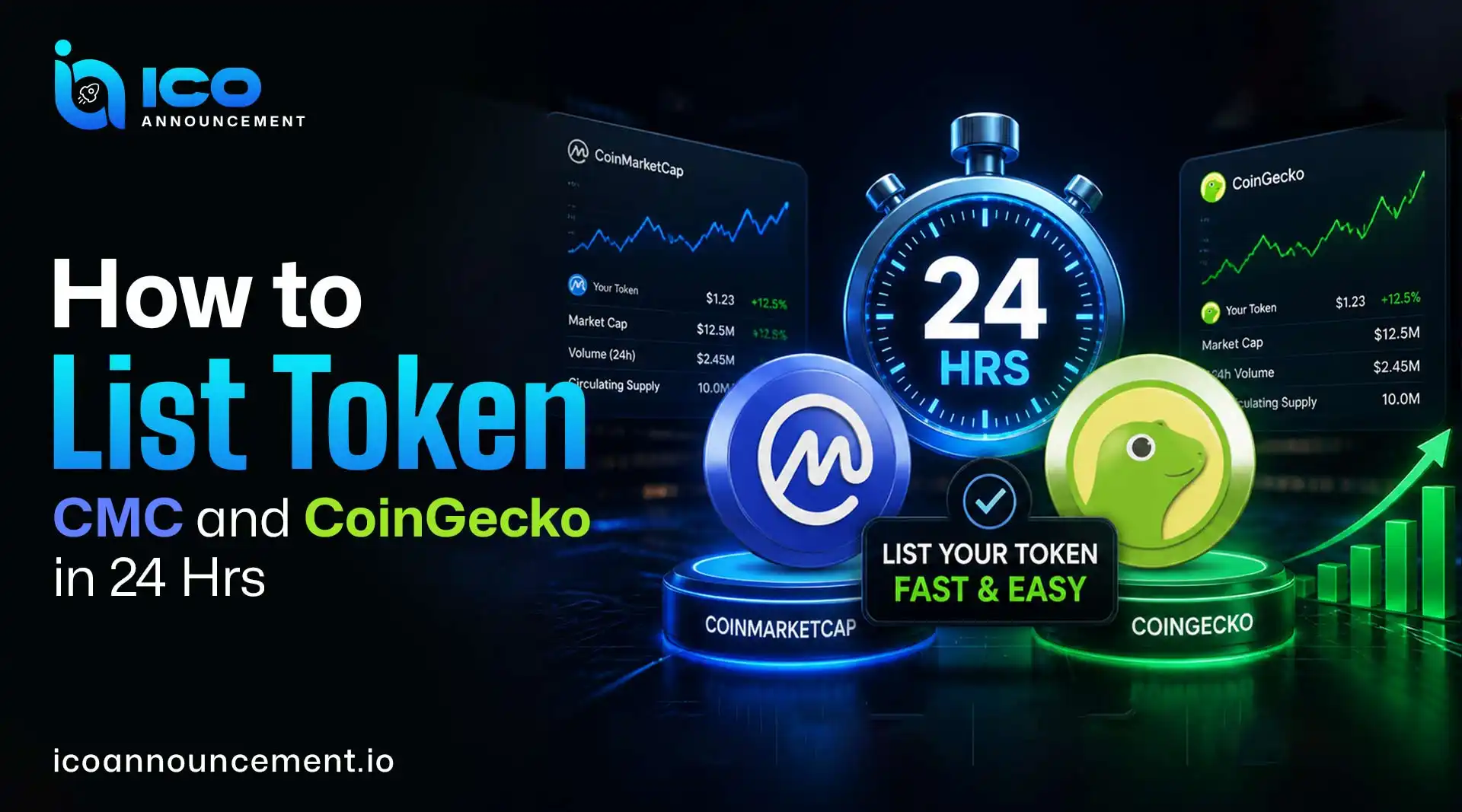
How to List Your Token on CoinGecko and CoinMarketCap in 24 Hours
Getting your cryptocurrency project listed on CoinGecko (CG) and CoinMarketCap (CMC) is the ultimate "stamp of approval." It provides visibility, price tracking, and trust for your community. However, thousands of tokens are rejected every month because of simple paperwork errors or a lack of transparency.
While the actual review process by these platforms usually takes 3 to 5 business days, you can prepare your project so perfectly that the initial submission is processed in record time. This List Your Token on CoinGecko and CoinMarketCap guide breaks down the exact steps to get your token listed efficiently and safely.
1. Required Documents and KYC Details
Before you open the application forms, you need a "Digital Press Kit." Having these ready prevents the back-and-forth emails that delay listings for weeks.
Professional Project Verification
Both platforms require proof that the project is legitimate. You will need:
Official Website: A high-quality, functional site with a clear roadmap, team section, and whitepaper.
Whitepaper: A PDF or GitBook explaining the utility, tokenomics, and technical architecture.
Contact Email: Use a domain-specific email. Applications from Gmail or ProtonMail are often flagged as "low-trust."
KYC and Transparency
While many DeFi projects remain anonymous, CoinMarketCap has shifted toward a more rigorous verification process. If your team is "doxxed" (publicly known), provide LinkedIn profiles. If not, having a third-party KYC certificate from a reputable security firm like CertiK or SolidProof can significantly speed up your approval.
2. API and Liquidity Requirements
You cannot list a token that has no trading activity. These platforms are "aggregators," meaning they pull data from exchanges. If there is no data to pull, there is nothing to list.
The Liquidity Threshold
To be taken seriously, your token should have:
Minimum Liquidity: Generally, at least $10,000–$50,000 in locked liquidity on a Decentralized Exchange (DEX) like Uniswap, PancakeSwap, or Raydium.
Trading Volume: Organic daily trading volume. If your volume is $0, the platforms will ignore the application.
Working APIs
The platforms use APIs to track your price and circulating supply.
Contract Address: Ensure your contract is verified on block explorers like Etherscan or BSCScan.
Circulating Supply: You must provide a way for CG and CMC to verify how many tokens are actually in the hands of the public versus locked in wallets. If your supply data is "hidden," your listing will be rejected.
3. Common Rejection Errors
Most founders fail not because their project is bad, but because their application is messy. Avoid these "instant-reject" mistakes:
Broken Social Links: If your Twitter (X) or Telegram links are broken or lead to inactive accounts, the reviewer will move to the next application in seconds.
Incomplete Tokenomics: If the math doesn't add up (e.g., total supply doesn't match the sum of all wallets), it looks suspicious.
Placeholder Websites: Never apply with a "Coming Soon" page. Your site must be 100% finished.
Low Community Engagement: If you have 50,000 Twitter followers but only 2 people talking in your Telegram, reviewers may suspect "bought" followers and reject you for lack of organic interest.
4. Fast-Track Tips: Audit and Socials
To move your application to the top of the pile, you need to prove your project is secure and active.
Get a Smart Contract Audit
A security audit is the single most important document you can provide. It shows that your code is safe from hacks. Projects with audits from recognized firms are prioritized because they represent a lower risk to the platform’s reputation.
Clean Up Your Socials
Reviewers check your community. Ensure:
Twitter (X): Consistent posting and genuine interaction.
Telegram/Discord: Active moderators and a helpful community.
Block Explorer Information: Update your token’s logo and social links on Etherscan/BSCScan. CMC and CG often cross-reference this data.
Self-Reporting Dashboards
Once you submit, use the CoinMarketCap Self-Reporting Dashboard. This allows you to update your project’s info in real-time, which reduces the manual work the CMC team has to do.
5. Post-Listing Price Management
Once you are listed, the work doesn't stop. A listing is a tool, not a finish line.
Verify Supply: Work with the platforms to get your "Circulating Supply" verified. This gives you a Market Cap rank, which is essential for investor confidence.
Update Exchange Links: As you get listed on more exchanges (CEXs or DEXs), update your listing info immediately. This ensures your "Global Average Price" is accurate.
Monitor for Spikes: Sometimes, new listings attract "pump and dump" bots. Keep your community informed and maintain steady communication to prevent panic selling.
Important Warning: Avoid "Fast-Track" Scams
As soon as you launch a token, you will likely receive DMs from people claiming they work for CoinGecko or CoinMarketCap. They will offer to "guarantee a listing in 24 hours" for a fee (usually $2,000 to $5,000).
These are scams.
Official Channels Only: Both platforms only accept applications through their official websites:
CoinGecko and CoinMarketCap: Use the official request form found at the bottom of their homepage.
No "Internal" Shortcuts: There is no "pay-to-play" for a standard listing. Fees are only involved for specific advertising or premium data services, never for the basic review.
Reality Check: A legitimate review takes 3 to 5 business days. Anyone promising a 24-hour guarantee is likely trying to steal your funds.
Final Thoughts
List Your Token on CoinGecko and CoinMarketCap and build trust and bring new users. You can submit in one day, but approval takes time and depends on your project. Focus on real liquidity, clear data, strong community, and honest updates. Avoid shortcuts, because a safe and clean listing always works better in the long run.