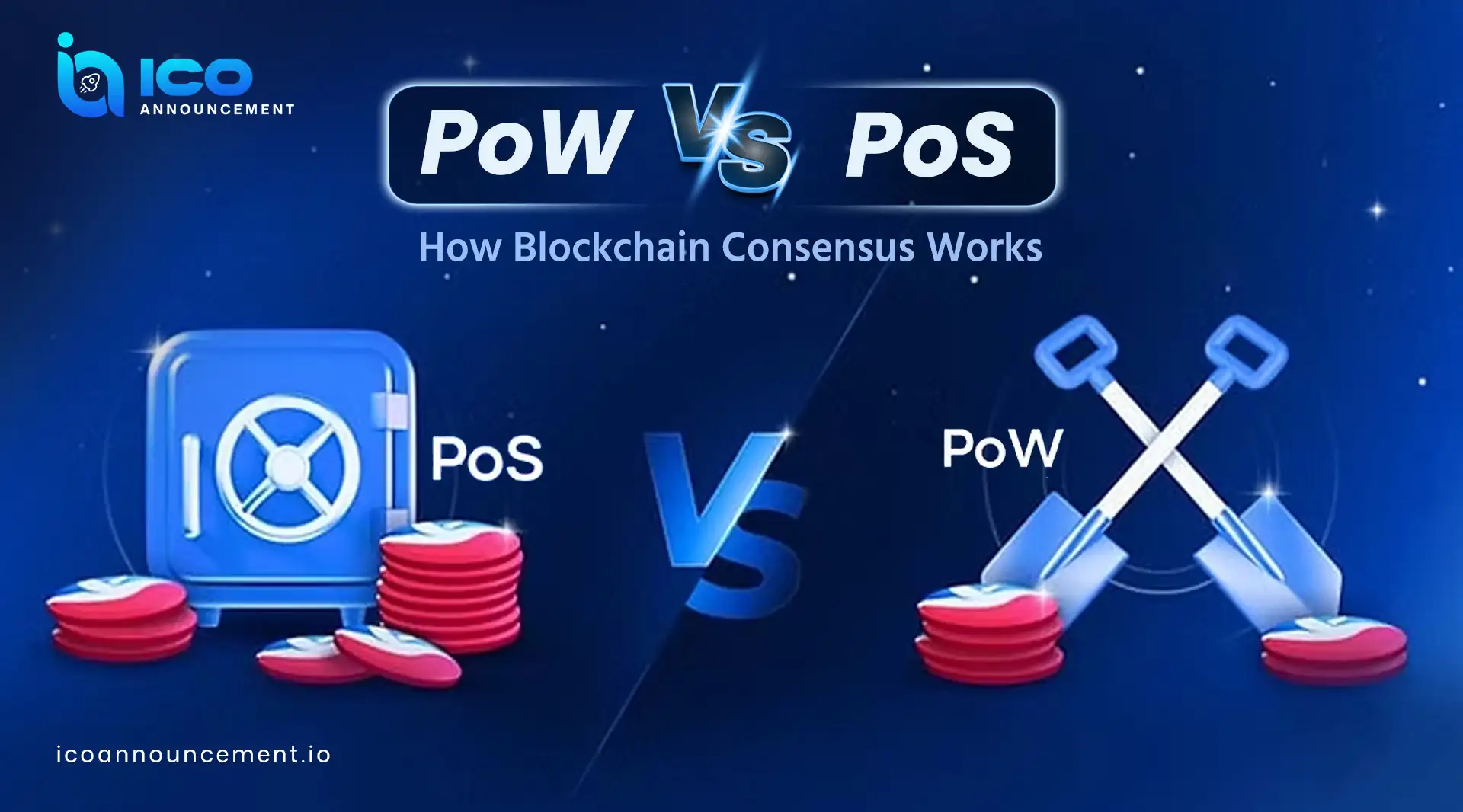
Simple Breakdown of PoW and PoS: How They Keep the Blockchain Safe
Blockchain might sound like a big and hard topic, but it does not have to be. In simple words, a blockchain is like a huge digital notebook that many people share. No one person controls it. Everyone who uses it can see the notes inside. Because so many people use it, the notebook must stay safe and correct at all times. To do this, blockchains use a system called consensus. When people talk about consensus they often talk about PoW vs PoS.
Consensus means everyone agrees on what is true. For a blockchain, this means people must agree on which blocks of data should be added, and in what order. Two main systems help blockchains reach this agreement: Proof of Work and Proof of Stake.
Both systems work well, but they do so in different ways. This blog will explain each one in very simple words, show how they are different, and help you understand why blockchains use them.
What is Consensus?
Before we talk about PoW Vs PoS, let us look at what consensus means in a blockchain.
Imagine a class where kids want to put their test scores on one small board. But the board can show only one score at a time. Since many kids want to write at once, they all need to agree on who will write next. They must choose a fair way to decide whose turn it is.
A blockchain works in the same way. Many people want to add new “blocks” of data. But only one block can be added at a time. Consensus PoW vs PoS decides who gets to add that block.
PoW Vs PoS keeps the blockchain:
Safe
Honest
Fair
Hard to cheat
Now let us learn about the two most common consensus systems PoW vs PoS.
What is proof-of-work?
Proof of Work was the very first major method used by blockchains and Bitcoin still uses it, along with a bunch of other older ones.
In Proof of work the folks who keep the network running are called miners. They use their computers to tackle these super tough math problems that require a lot of energy. Whoever's computer cracks the puzzle first gets to add the next block of data to the chain.
How Proof of work works
A bunch of computers compete to solve the puzzle.
The puzzle is super hard, so computers must work fast
The first one to solve it, wins.
That computer adds the new block to the chain.
The winner gets a reward, often a coin like bitcoin.
Why PoW is safe
Because the puzzles in Proof of work are very hard, a person would need a huge amount of computer power to cheat the system. This also means they would spend a lot of money and energy. If someone tried to take over the network, they would still need more computer power than everyone else, which is very hard to get. This high cost and effort make Proof of work very safe and hard to attack
Why Proof of work has some problem
It is safe but it has some issues
It uses lot of electricity
It needs strong and costly machines
It can be slow when many people use the network
Even with these issues, it is trusted because it has been used for many years and proven to work well.
What is Proof of Stake
Proof of Stake is a newer method. Many modern blockchains use it, such as Ethereum (after its upgrade), Solana, and others. In proof of stake, instead of solving puzzles, people help run the network by locking up coins. This is called staking. The more coins you stake, the higher your chance to add the next block. People who stake coins are called validators, not miners.
How Proof of stake work
You lock some of your coins in the network
The network picks one validator to make the next block
You do not need strong computers
If you try to cheat, you can lose your staked coins
If you do your job right you earn rewards
Why Proof of stake is safe
Proof of stake is safe because people who want to cheat must risk their own money. If they lie or add wrong data, the network can take away part of their stake. This gives people a strong reason to be honest.
Why Proof of stake is good
It uses very little energy
It does not need strong machines
It can be faster than Proof of work
It can handle more users at the same time
This is why many Blockchain Pick Proof of stake.
How PoW Vs PoS are different
Here is an easy way to understand the difference among PoW Vs PoS:
In Proof of work you win the chance to add a block by working hard with computers, in PoS you win a chance to add a block by staking coins and being trusted.
PoW needs very high power, it needs very less power
PoW is slower and PoS is Faster
PoW operates in high hardware cost and other one operates in low hardware cost
Both PoW vs PoS system aims to keep blockchain safe and fair.
Why blockchains needs consensus
Blockchains are not run by one boss. Many people all over the world help run them. Because of this, the system must pick one (PoW vs PoS) honest way to add and check blocks.
Consensus helps blockchains:
Stop cheating
Stop fake blocks
Make sure data is the same for all users
Keep the system open
Build trust without a central leader
Without consensus, a blockchain would break. Anyone could change data. The whole system would fall apart.
Which one is better
There is no simple answer. Both PoW Vs PoS have a place in the blockchain world.
Why Some Like PoW
It has been tested for many years.
It is hard to attack.
It is trusted by early users.
Why Some Like PoS
It uses less energy.
It is better for the planet.
It's quick and can support a lot more people.
More users can get involved, as it does not need high power
Many users believe PoW is great for money systems like Bitcoin, and PoS is great for modern apps, games, and smart contracts.
What the future may look like
More blockchains may start using Proof of staking because it is faster and uses less energy. But the old system is still important because it is very secure and has been trusted for a long time. It is not likely that one system will take over completely.
Both poW vs PoS systems will probably stay, and each blockchain will choose the one that fits its needs.
Conclusion
PoW Vs PoS are two ways that blockchains stay safe and fair. In PoW, computers do hard work to choose who will add the next block. In PoS, people lock their coins to get a chance to add the block. Both systems help the network agree on what information is correct.
You do not need to understand all the math or coding behind them. The main idea is that these systems help everyone follow the same truth.
With PoW Vs PoS, blockchains can run without one boss, stay safe from attacks, and let people trust the system online.